Month 1:21, Week 3:6, Year Days 021
2Exodus 13/40
Gregorian Calendar: Wednesday 8 April 2026
Chag haMatzah VII 2026
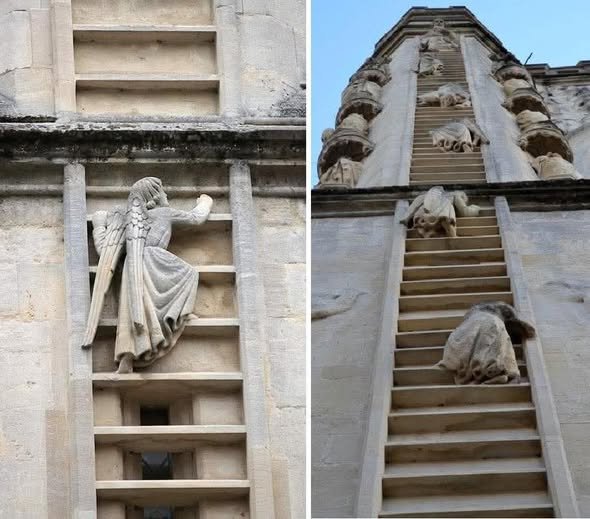
The Stairway, House & Son
Part B1 - The Story of Jacob I
Continued from Part 3 (The Stone, Stairway, House & Son
Part A - The Story of Nathanael)
Continued from Part 4 (Spring Moedim, Chag haMatzah II & Yom haBikkurim)
Owing to illness, this sermon was not recorded until 19 April 2026
Introduction
Shabbat Shalom and welcome to the seventh and final day of Chag haMatzah or the Feast of Unleavened Bread and to the last day of the annual spring festivals. The message I have for you today was to have been given on Day #3 but I was so ill, and for the days afterwards, plus I had to deal with another ongoing medical emergency, that of my daughter. Gone are the days when I would give a teaching on every day of the festival! So I was forced to take a complete break. Then the sermon was completely lost thanks to a software fault and had to be painstakingly reconstructed. My only concern is you may have forgotten the first part of this message given some days ago now so I need to carefully go over that material again as well as share some new insights before we get underway with the second part.
A. SUMMARY OF THE NATHANAEL STORY
We started on the first day of Chag haMatzah with the story of honest Nathanael, whom Yah'shua (Jesus) called a "true Israelite" - authentic, genuine, up-front and as honest as the day is long, if a tad rude about the inhabitants of Nazareth! A friend of the apostle Philip who had been telling him about Yah'shua (Jesus), he had remained unconvinced of His Messiahship until the Saviour had described what he had been doing, sitting under a fig tree, without Yah'shua (Jesus) having been anywhere in the vicinity and without Him being informed by Philip. Philip's testimony, previously preposterous to his carnal mind, suddenly became utterly believable to him. The Saviour's vision was the catalyst that would propel him to faith. A small matter, we might think, but perfect for the moment, meeting his immediate need. Yah'shua (Jesus) was so impressed by Nathanael's response that He promised this son of Judah that the day would come when he would be a witness to something only Jacob, the father of Israel, and perhaps Daniel too, had ever seen:
"I tell you the truth, you shall see heaven open, and the malakim (angels) of Elohim (God) ascending and descending on the Son of Man'" (Jn.1:51, NIV).
Nathanael, the Apostle Bartholomew, India & Armenia
Nathanael is traditionally associated with the Apostle Bartholomew (Heb. Bar-Tolmai = 'son of Tolmai') who was born in Cana of Galilee. He was called by Yah'shua (Jesus) in John 1:45-51 and we find him included in the apostolic lists in the Gospels and in Acts (Mt.10:3; Mk.3:18; Lk.6:14; Ac.1:13). After the first Messianic Shavu'ot or Feast of Weeks known by most as 'Pentecost', Bartholomew travelled to preach the Besorah (Gospel) in India (where he left a copy of the Gospel of Matthew behind), in Mesopotamia, Parthia (Persia, now Iran) and Armenia. He worked closely with the Apostle Philip who introduced Him to Yah'shua (Jesus) as we saw, turning up later in Asia Minor and Syria. He was martyred in Armenia by being flayed and beheaded by King Astyages for converting people to Christianity. Prior to his death he was known to have cast out demons and healed the sick, converting King Polymius. Pagan priests pressured King Astyages to have him skinned alive and decapitated. Little wonder he is the patron saints in the Eastern Orthodox tradition of Armenia, my eldest daughter and son themselves being part Armenian so I have a special interest in the Caucasus nations of Georgia and Armenia for family reasons. Their maternal grandfather was born in Baghdad to an Armenian mother, which was then part of the Ottoman Empire, now Iraq, the capture of which by the British army on 11 March 1917 my paternal grandfather participated in as a cavalryman.
From Guileless Sceptic to Apostle and Martyr
So this is who Nathanael became and what he did. He is known as the apostle to India and Armenia. And if you want to know more 'coincidences' in my life story, know also that my mother lived in India a while after World War 2 and my first wife (who was half Norwegian, a quarter English and a quarter Armenian) was born in India, in Bombay (now Mumbai). As a ministry we have had strong associations with India, managing an orphanage in Madras (now Chennai) for many years and raising many congregations in Andhra Pradesh state at one time. So no wonder Nathanael's spiritual anointing is compared to that of the Patriarch Jacob who is the subject of today's message!
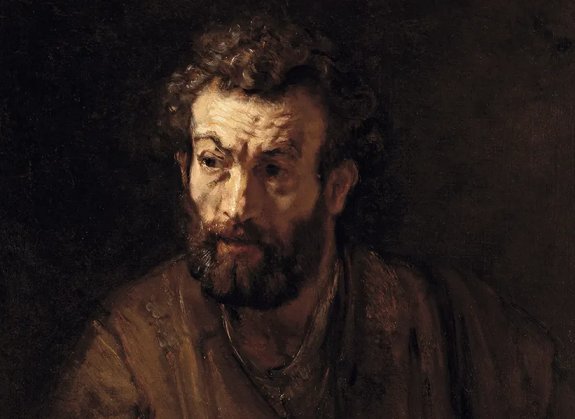 Nathanael and the apostle Bartholomew were one-and-the-same person
B. THE JACOB STORY, PART 1
We are All Jacob the Deceiver When We Operate in the Flesh
We need to look at the life of Jacob is some detail today for the very simple reason that Jacob is us - both the unsaved us and the saved but sin-compromised us, yet with a mighty calling on him nonetheless. We will never properly understand the relationship between Jacob and Israel - his new name after he had finally become an overcomer (Gen.32:28) - until we know the carnal man Jacob a lot better. Nathanael (or Bartholomew) was his descendant far in the future. So let's get into the story, which is also our story, as you will see, in so many alarming ways. Genesis accordingly, and for other reasons too, underlines the importance of Jacob, if for no other reason than the Hebrew people were known by his name thereafter. That name, which in the Hebrew is Ya'akov, literally (and unflatteringly) means 'trickster' or 'deceiver', prophetically given him by his father Isaac. His life was an epitome of the life of the whole race that descended from him, so to understand Jacob is to simultaneously understand Israelite history throughout the centuries, though really we should call it 'Jacobite' history, again for reasons you'll quickly appreciate.
Weaknesses, Aspirations & Sorrows
Jacob's weaknesses, aspirations, and sorrows are graphically portrayed in the narrative. His story shows how a character, in which there was a strange mixture of good and evil, can be strengthened and transformed by discipline. His career is worthy of our careful study today for the sake of the play and interplay of conflicting forces which it reveals both in him, in his descendants, and in us. Jacob is a type of the honest - sometimes unregenerated and sometimes compromised - seeker from every race, kindred and tongue...you and me. His story in Genesis has a deeper purpose than we might at first suppose, and that is to show us how Yahweh was able to make use of an imperfect man in the achievement of His purposes. I want you to rememebr this well so that you don't throw in the towel (give up) when you see your many defects: our Heavenly Father uses our imperfections to realise His will in us and in those we serve. We are still useful and have a purpose during this spiritual developmental stage of our lives!
The Heavy Responsibility and Privilege of the Birthright
Early on Jacob had already shown indications of his desire to 'steal a march' on his elder brother, Esau, who you will remember was his elder only by a matter of minutes. In Genesis 25:29-34 we read the story of how Easu one day came in hungry from hunting, and Jacob, quick to seize advantage of the situation by means of a carnal strategem, offered Esau bread and stew (called 'pottage' in the KJV) in exchange for his birthright. For those unfamiliar with the biblical concept of a 'birthright', this was (and still is - or ought to be) a special privilege, inheritance, and authority given to the firstborn son in a family, in which he received a double portion of his father's estate, became the head of the family after the father's death, and obtained his family priesthood (which in those days before Moses was the Melchizedek Priesthood, as it is again today in the New Covenant). This double portion was not for the use of the elder son's own pleasure but was to be used to help other family members in need as required, as well as to take care of the late father's widow - his own mother - so that she would not be left destitute, unprotected and uncared for in the vulnerability of her old age. This usually meant that the mother of the family lived with the firstborn son, in the same way Yah'shua (Jesus) appointed the apostle John the custodian of His own mother, Mary, whom he took with him to Ephesus. This was a major responsibility, but also one that held great prestige, rightfully so because of the care and labour involved, and the numerous blessings from Yahweh. Think forward to how Jacob's son Joseph, who replaced Reuben as the firstborn son after the latter's disgrace, became the new firstborn and how he rescued his whole family, including his father (for his mother had died), from certain death through starvation during the seven years of famine.
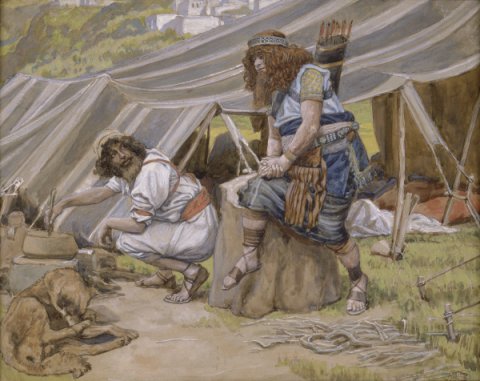 Carnal Esau sells his birthright to Jacob for a mere bowl of stew
Rebekah's Loss of Character
The story goes that Esau, who cared more about his belly in the immediacy of the moment, thinking more about relieving his hunger than being concerned about his future responsibilities, agreed to the bargain, showing how unspiritual a man he really was. This was a portent of a similar event to follow. And, sadly, Rebekah his mother was not without blame in this whole sordid affair. She seems to have degenerated in character since those romantic days when she rode out on a camel to become the bride of Isaac, and to a marriage made in heaven by the Creator Himself. She overheard Isaac one day ask Esau to get venison and make savoury meat, that he might give him a blessing. Taking advantage of Isaac's age and blindness, she conceived the idea of dressing up Jacob to impersonate his brother. At first Jacob was afraid of the risk involved, but prevailed upon by his mother, he went into his father to carry out the deed. Isaac was at first doubtful whether it really was Esau. "The voice is Jacob's voice, but the hands are the hands of Esau", said the agèd Isaac (Gen.27:22, NRSV). But eventually he was convinced, and gave Jacob the coveted blessing:
"May Elohim (God) give you the dew of heaven, and of the fatness of the earth, and plenty of grain and wine. Let peoples serve you, and nations bow down to you. Be lord over your brothers, and may your mother's sons bow down to you" (Gen.27:28-29, NRSV).
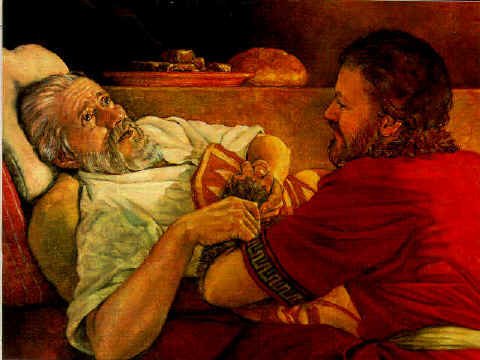 Goaded by his mother Rebekah, Jacob deceives his blind father, Isaac
The Fraud Discovered & the Consequences
Shortly afterwards, the fraud was discovered. In anger Esau raised his voice and wept, begging his father to give him a blessing. Isaac, who loved his son, could not resist this plea, and spoke prophetically to him:
"See, far away from the fatness if the earth shall your home be, and away from the dew of heaven on high. By your sword you shall live, and you shall serve your brother; but when you break loose, you shall break his yoke from your neck" (Gen.27:39-40, NRSV).
Esau's Poor Marriage Choices & Jacob's Need for a Wife
And though Esau had been grievously wronged, you can easily understand a carnal man's reaction to that pronouncement by his father, for Esau swore vengeance on his brother Jacob, and when Rebekah heard of her favourite son's danger, she urged him to flee to Paddan-Aram to his uncle Laban until Esau's anger had subsided. But there was another reason Jacob had to leave home because his father had previously instructed him to journey to Paddan-Aram and find a wife from among his relatives. So Jacob would have had to have left anyway because there was no marriageable material in pagan Canaan. We may therefore assume that Esau's wrath brought the timetable forward somewhat. By this time Esau had already married two pagan wives, two Hittites: Basemath (who was given the Hebrew name Adah) and Judith. His so becoming unequally yoked with unbelievers had understandably greatly distressed his parents (Gen.26:34-35). So in order to placate Isaac and Rebekah somewhat, he took a third wife called Mahalath, also known as Bashernath, who was at least his cousin and the daughter of his uncle Ishmael, and sister of Nebaioth, a closer relative (Gen.28:9; Is.60:7). Esau's half-Hittite children would become the forefathers of the Edomites and Amalekites, two of Israel's bitterest future enemies, reminding us that there are consequences for future generations because of our sinning and why it is so important to yield to Yahweh's choices in our marriage selections.
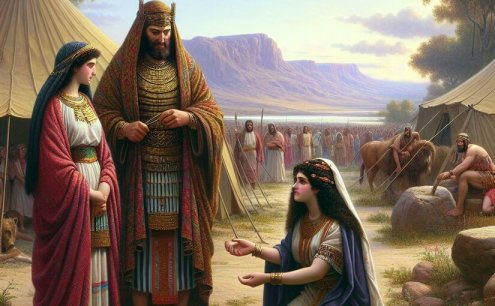 Esau's pagan Hittite wives greatly displeased his parents
Jacob's Stairway
So this is the background to Jacob's first big 'mess', revealing an ugly carnal side to his nature. It's the second part of the biblical account, which is one of the best known stories from the Tanakh (Old Testament), that particularly interests us today because of what Yah'shua (Jesus) said to Nathanael, the future apostle Bartholomew. I speak now of the account of 'Jacob's Ladder' or Sullam Ya'akov as it's called in Hebrew, though 'ladder' is a poor translation and the Hebrew sullam is best translated here as 'stairway'. This means that Bishop Oliver King's dream was influenced by wrong thinking, and hence the carving of a ladder on the two towers of Bath Abbey is almost certainly an incorrect depiction of what happened in reality. Let this be an important reminder that the symbolism in our dreams is commonly the result of an inner mental process in which concepts pass through various filters drawn from our imperfect knowledge-base. So we should not be too surprised (or dismayed) if our dream content doesn't exactly match reality and therefore we should not automatically assume that it is uninspired. Bishop King, after all, lived in a Catholic age. So with a stone for a pillow Jacob lay down to sleep en route to Paddan-Aram, the modern Harran in southern Turkey:
"And he dreamed that there was a stairway (Heb. sullam) set up on the earth, the top of it reaching heaven; and the malakim (angels) of Elohim (God) were ascending and descending on it. And Yahweh stood above it ('beside him', variant) and said, 'I am Yahweh, the Elohim (God) of Abraham your father and the Elohim (God) of Isaac; the land on which you lie I will give to you and your offspring, and your offspring shall be like the dust...and all the families of the earth shall be blessed in you and your offspring. Know that I am with you and will keep you wherever you go..." (Gen.28:12-15, NRSV).
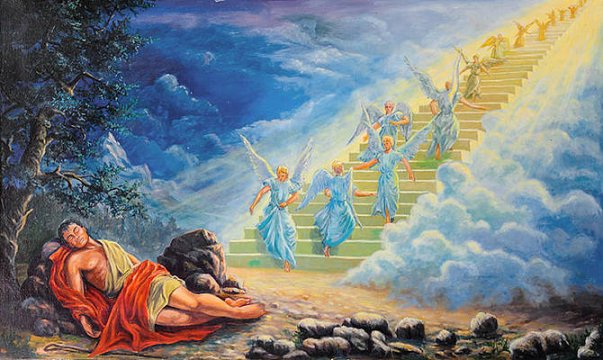 Jacob's 'ladder' was, in fact, a stairway with Yahweh at the top
Jacob Consecrates the Stone Pillow
In fear and reverence, Jacob took the stone, on which his head had rested, and made it into a pillar, poured oil on it, and made a vow:
"If Elohim (God) will be with me, and will keep me [safe] in this way that I go, and will give me bread to eat and clothing to wear, so that I come again to my father's house in peace, then Yahweh shall be my Elohim (God), and this stone, which I have set up for a pillar, shall be El[ohim]'s (God's) house (Beth-El); and of all that You give me I will surely give one-tenth to You" (Gen.20-22, NRSV).
Early Stages in Jacob's Spiritual Journey - a Bargaining Mindset
There are two things I want you to carefully make a mental note of here:
- 1. That it is the stone pillow that he names 'House of God' or Bethel - only later does he extend this name to include the whole area of Luz (itself meaning 'light'); and
- 2. The content of this vow and the way it is worded because in reality this is more in the nature of a bargain than a solemn dedication to the service of Yahweh!
As far as the second point is concerned, realise also that though it falls short of a true unconditional covenant (such as the nation of Israel would take at Mount Sinai under Moses), it does at least show Jacob resolved to mend his ways and reveals an important (and praiseworthy) stage in this carnal man's progress - progress away from the principle of self-aggrandisement, though he has far to go on his spiritual journey yet! What we are seeing here is a recognition that Elohim (God) is now in his life far more than he had previously allowed. In other words, it's an early stage in his spiritual growth not unlike Nathanael's early testimony.
We are Not Overcomers Immediately
And this is the point I want to stress to you, something very important about the 'spirit of Jacob', if we may call it that. Jacob, who is not yet an overcomer, is a 'mixed bag'. What that means is that all of us are 'mixed bags', spiritually speaking, when we start out on our spiritual journey, and that we don't - if we persist in our spiritual journey - become overcomers right away. And that's OK. It's normal but we mustn't become discouraged if at first we don't succeed or make that an excuse not to persist. Jacob has yet to be refined and tested. The important thing is not to be discouraged by our failures (which are many in life) but rather be encouraged that in facing the right direction and moving steadily forwards, at whatever pace, we are truly on our way, and is the evidence that we are 'saved'. That's what matters, and that we keep heading toward Yahweh, for the opportunity for a final overcoming will come if we don't fall away first. It takes a long time for Jacob to earn his new name, Israel, which is why we should never bandy it around casually. For we may not have yet earned it. And even then he still made mistakes, as we shall see from the account, but there had definitely been a quantum leap in his spiritual life after the struggle he had with a malak (angel) on his homeward-bound journey.
Friends of Elohim Always Start as Servants
The difference between between Jacob and Israel, as we shall soon discover, is the difference between a servant and an intimate friend of Elohim (God). In so many ways it's like the difference between a Deacon and an Elder, remembering that 'once a deacon, always a deacon'. An Elder never stops being a Deacon because he is both Servant and Friend. Far too many believers assume that friendship with Elohim (God) is automatic upon confession of faith or special 'anointing' (like 'tongues') when it absolutely isn't - we must first be tested, chizzled, smelted, and pruned.
OSAS, Predestined Salvation & Other Lies Modern Christians Believe
So don't assume you have 'made it' upon your first confession of faith as certain evangelicals do. This carelessness and arrogance can lead believers with that attitude to have a mighty fall for in making the false 'Once Saved, Always Saved (OSAS)' assumption, they are, in their conceit, saying they want nothing to do with Chag haMatzah - the Feast of Unleavened Bread - at all! They're not going to work on their sin-problem or striving for holiness.
"Strive for peace with everyone, and for the holiness without which no one will ever see the Master (Lord)" (Heb.12:12.14, ESV).
Indeed they're claiming that they don't sin any more because of their initial confession of faith in Christ or claimed 'baptism of the Holy Ghost' with 'tongues' as the required evidence that this is so. That's why John warned against such a destructive mindset:
"If we say we have not sinned, we make Him (Yahweh) to be a liar, His Davar (Word) is not in us" (1 Jn.1:10, ESV; cp. v.8).
The Journey is Divided into Three Parts, like Marriage
They confuse admission to the Kingdom of Heaven with graduation to Bride status, believing (in the case of Calvinist belief) that they cannot fail or lose their salvation because they're already predestined to be 'God's special kids' and were always saved. They confuse the very real differences between:
- 1. Dedication;
- 2. Betrothal (what moderns wrongly call 'engagement'); and
- 3. Actual Marriage.
It's a three-stage journey, just as there are Spring, Summer and Autumn (Fall) annual festivals, and just as there are three different resurrection glories (1 Cor.15:41). So behaviour often doesn't matter to lawless OSAS people very much. The story of Jacob gives the lie to that mistaken belief, as does Christ who shows this is an ongoing principle in the New Covenant. What they don't understand is that Yah'shua (Jesus) didn't abolish the Torah but rather it's penalties for sinning so long as we genuinely repent by proactively changing the direction of our lives.
Conclusion
We will resume this story next time in Part B2, Yah willing! In the meantime, may Father Yahweh bless you and keep you in Yah'shua's (Jesus') precious Name. Amen.
Continued in Part B2 (The Stone, Stairway, House & Son)
 V503
V503

|