Month 1:15, Week 2:7, Year Days 015
2Exodus 13/40
Gregorian Calendar: Thursday 2 April 2026
Chag haMatzah I 2026
Continued from Part 2 (Spring Moedim, Pesach)
The Stone, Stairway, House & Son
Part A - The Story of Nathanael
Introduction
Chag haMatzah Sameach kol beit Yisra'el and Mishpachah. Welcome, come and join with me today on this the first of seven days of the Feast of Unleavened Bread in which the Day of Resurrection is embedded on the second day, tomorrow, and to a strange and astonishing story. For I have been on an unexpected journey these past two days, one that I would never have conjured up in my wildest imagination when I first asked Father, 'What do you want me to talk about on this the first day of the Feast of Unleavened Bread?'
Nathanael, the True Israelite
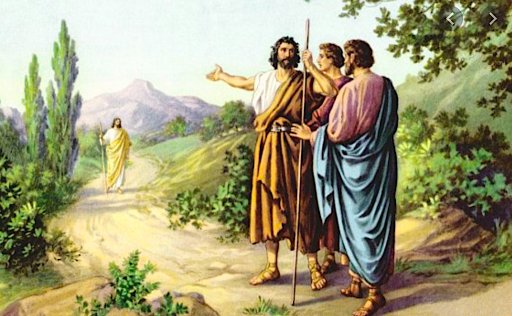
It is hard to know where to start so I elect to take you the end of my journey first, so let us go back in time to the first chapter of the Gospel of John, and to thje brief account of an honest true Israelite named Nathanael. An interesting man with an interesting name. It literally means 'El (God) has given' or 'Gift of El (God)'. It's a name that signifies gratitude for a child. His parents must have been filled with delight with their newborn son. We'll take up the story from verse 43:
"The next day Yah'shua (Jesus) decided to leave for Galilee. Finding Philip, he said to him, 'Follow Me.' Philip, like Andrew and Peter, was from the town of Bethsaida. Philip found Nathanael and told him, 'We have found the one Moses wrote about in the Torah (Law), and about whom the nevi'im (prophets) also wrote - Yah'shua (Jesus) of Nazareth, the son of Joseph.' 'Nazareth! Can anything good come from there?' Nathanael asked. 'Come and see,' said Philip. When Yah'shua (Jesus) saw Nathanael approaching, he said of him, 'Here is a true Israelite, in whom there is nothing false.' 'How do you know me?' Nathanael asked. Yah'shua (Jesus) answered, 'I saw you while you were still under the fig tree before Philip called you.' Then Nathanael declared, "Rabbi, you are the Son of Elohim (God); you are the King of Israel.' Yah'shua (Jesus) said, "You believe because I told you I saw you under the fig tree. You shall see greater things than that.' He then added, 'I tell you the truth, you shall see heaven open, and the malakim (angels) of Elohim (God) ascending and descending on the Son of Man'" (John 1:43-51, NIV).
Temple Language
Why did the Saviour say these words, "you shall see heaven open, and the malakim (angels) of Elohim (God) ascending and descending on the Son of Man", in verse 51? As you will better understand in a minute, He is using Temple language. Backtrack to verse 14 which gives greater context:
"The Davar (Word) became flesh and made His dwelling among us. We have seen His glory, the glory of the One and Only, who came from the Father, full of grace and truth" (John 1:14, NIV).
A Birth Day & a Death Day in One
You see, yesterday - Pesach, Passover - was not only the Day of Messiah's Crucifixion but also the Day that the Saviour was born into the world too. It is properly seen as Messiah's Nativity Day (not Christmas). It's a double event + simultaneously a Beginning and an Ending, a singular Alef and Taw, or Alpha and Omega (Rev.1:8; 21:6; 22:13) [1], pointing both to someone who existed within time as well as beyond time. And who was Yah'shua the Messiah (Jesis Christ)? He was Elohim (God) in the flesh, 'tablernacling' or 'temple-ing' into matter, what theologians call the Incarnation - Elohim (God) coming to dwell in Man.
The Incredible Incarnation
You cannot begin to understand the magnitude of this entemple-ing without understanding the scales involved. Imagine, if you will for a moment, two entire universes meeting or intersecting in this one Man who was also Elohim (God). Picture him holding one universe in His left hand and another in His right, and then drawing them together, and you have an idea of what the Incarnation means. It's impossible for us to fully understand it, of course, because of the limitations of language itself. What mankind witnessed in the conception of the Saviour in his earthly mother Mary was the joining together or two vast realms, one of matter and one of spirit - not colliding but seemingly effortlessly merging together into a new reality! In truth, it was a Restoratiin events, because these two universes had once been together as one, but were torn apart by the rebellion of Adam and Eve in the Garden of Eden. In one baby in Judean woman's womb in space-time, 1 BC in the Gregorian Calendar, we are witnesses to the greatest Healing Events in all time. In one baby coming into being as the result of a supernatural fertilisation, a baby that that was born into our world, who grew into an adult man, who came to share in the life of His covenant people Israel, you have the actualisation of an event so great, so marvelous, so indescribable, so glorious, that the only way the Ruach haQodesh (Holy Spirit) can convey this to the apostle John, is by relating an event about a down-to-earth man called Nathanael, spontaneously sceptical and cynical who, when confronted with truth, makes this fantastic leap of faith when Yahweh reveals to Him that the One he is seeing, like Peter in the near future, declares, astonishingly, "you are the Messiah (Christ), the Son of the living Elohim (God)" (Mt.16:16), a testimony again born by Martha in John 11:2, with all Jerusalem in His triumphal entry into that city likewise proclaiming, You are "the King of Israel" (Jn.12:13)!
From John to Genesis
And if you think that is amazing, Yah'shua (Jesus) amazes us even more still with a promise that takes us all the way back to Genesis, saying: "I tell you the truth, you shall see heaven open, and the malakim (angels) of Elohim (God) ascending and descending on the Son of Man". Nathanael will one day see as Jacob saw: the fullness, but for now he is only experiencing a little peek into truth, for that is how we must all start and grow in Christ. And all of this was mad epossible because he was an honest man, a 'man without guile' as this is rendered in the King James Version, a man totally open to truth, needing but the smallest prompt to set in motion the greatest personal journey any man or woman can make - the discovery that Yah'shua (Jesus) had forseen him sitting under a fig tree. Nothing more. This is the type of truth-based faith that comes from openly believing. Here Nathan is directly compared with the patriarch Jacob, one of a handful of esteemed men given the title, "friend of Elohim (God)" (Ex.33:11; Is.41:8; Prov.3:32; Jas.2:23), a man we never hear of again, even though scholars link him with Bartholomew the apostle, and I believe them to be right. He was after all, a close friend of Philip the apostle-to-be too. And all those apostles who were faithful He called 'friends', a promised extended to all His talmidim (disciples) if we are faithful servants first (Jn.15:13-15).
Saved by Faith
Honest scepticism with a willingness to then abandon scepticism for good by taking a giant leap of faith upon being confronted with sufficient evidence is the way men and women are born again. We all of us have enough evidence as to who Yah'shua (Jesus) truly is. The Bible contains that evidence. Forensic science gives us even more evidence should we need it. A love of truth openes a great highway to the most glorious heavenly revelation if we will but embrace it. You don't have to be a scholar, a theologian or a philosopher to know the truth: you just need to have a passionate love of truth, as Peter and Nathanael did, to know what the ultimate truth is for yourself, and that is who the man Yah'shua (Jesus) really is. We are all Peter, we are all Nathanael, if we so choose to be, and we can go from sitting under a tree, to meeting Yah'shua (Jesus) in the Davar (Word), to being transported into the highest heaven, in an instant, from whence all truth decends, a truth often born by malakim (angels) in small chunks that we can manage to chew on. Only Peter and Nathanael needed no angelic help to identify the One who alone could save them from themselves and from sin. They simply needed the trust that delivers, the faith that saves (Lk.7:50; Eph.2:5,8; 2 Tim.1:9).
What is a True Israelite?
That is not where my journey of the last 48 hours began, but where it ended. But I felt strongly to share the end with you first to encourage you, for my journey was a bit longer - literally (the last 48 hours) and metaphorically (the last 50 or so years). Who does not wish they were like Nathanael and receive such a spectacular revelation apparently effortlessly? Well, there's more to this than may at first meet the eye, and I wish to draw your attention to two words, and they are both critically important - "true Israelite" - not just 'Israelite', but 'true Israelite' as opposed to a 'false Israelite'. What is a 'true Israelite'? To answer that we must go farther back in time and to the meaning of this, the divine moed or appointment called Chag haMatzah - the Feast of Unleavened Bread.
The Twin Towers of Bath Abbey
And we are told where in the passage of Scripture I just read to you to go to back to the only other reference in Scripture to malakim (angels) ascending and descending - to the stairway commonly called 'Jacob's Ladder'. For it's for that reason I have chosen a couple of pictures to show you, both from Bath Abbey in England, because of its unique, and remarkable carving in stone. Properly known as , it is a former Benedictine monastery in Somerset build in the 1860's, a remarkable piece of what is called 'Perpendicular Gothic' architecture. Its uniquely towers, each with the same carving, was inspired by a dream of Bishop Oliver King in 1500. He had a vision of the Elohimhead (Godhead) and of angels on a ladder, which prompted him to rebuild what was by then the ruined abbey at Bath. At the top of each of the two towers on the main west front, right next to the entrance, is a representation of Elohim (God) Himself. This piece of architecture is as unique as the event it depicts to which we have returned to be inspired and to give us a visual image of what I want to talk about for the remainder of this Feast of Unleavened Bread.
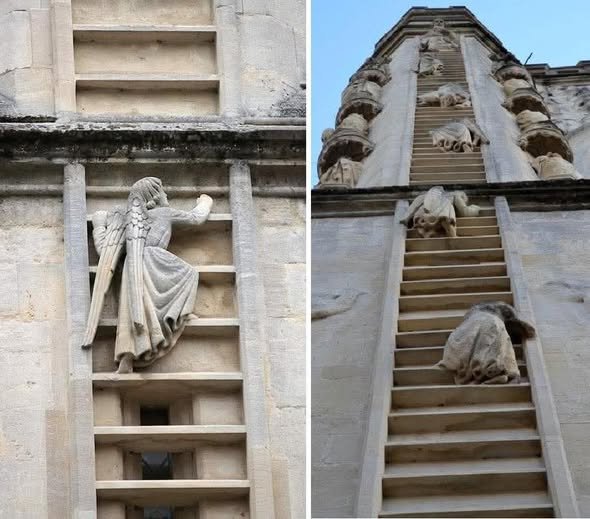 The Towers of the Abbey of Saint Peter and Saint Paul, Bath, England
Conclusion
But we're going to have to interrupt that story today because tomorrow, on the second day if Chag haMatzah, Yahweh has commanded to divert out attention to the symbolism of this second annual festivals to the third and final of the three spring festivals known as Yom haBikkurim which means the 'Day of Firstfruit' which we will be looking at tomorrow. Only when we have done that may we return to the theme of Chag haMatazah and to the story I have been telling you today. So bear with me, please, we shall continue the story of Nathanael and Jacob in a couple of days' time. In the meantime, have a blessed Sabbath and I will see you again on what is properly called Resurrection Day or the 'real Easter'. Amen.
Continued in Part 4 (Spring Moedim, Yom haBikkurim)
Continued in Part 5 (The Stone, the Stairway, the House & the Son, Part B1)
Endnotes
[1] See, Why We Believe Messiah was Born on Passover: 25 December, 6 January, Tabernacles or Passover?
 V501
V501

|