Month 7:9, Week 2:1, Year Days 185
2Exodus 12/40
Gregorian Calendar: Tuesday 30 September - Wednesday 1 October 2025
Yom haKippurim 2025
Vindication of the Righteous

Day #1 (30 September 2025)
The Yah'shua Prayer
Introduction
Chag sameach Yom haKippurim and Shabbat Shalom kol beit Yisra'el as we gather once more, this time fasting rather than feasting, to observe the sacred moed or appointment, which is the Day of Atonements. We do so not for ourselves individually (which we did at Pesach or Passover representing Christ's atonement for our individual sins, Chag haMatzah or the Feast of Unleavened Bread representing our repentance from individual sinning, and Yom haBikkurim or the Feast of Firstfruits representing our future individual resurrections) but as a corporate body of believers - one community within the Nation of Messianic Israel whose King and eternal Cohen Gadol (High Priest) is Yah'shua the Messiah (Jesus Christ). If Yom Teruah, the Day of Twin-Silver Trumpets and Shouting (which we observed 8 days ago) was our collective 'joyful hope' announcing the return of Christ, then Yom haKippurim may be said to be the collective 'vindication of the righteous'. For on the final Day of Atonements, Yah'shua (Jesus) will judge the world and bring the present wicked Babylonian system to an abrupt and unceremonious end by means of much destruction.
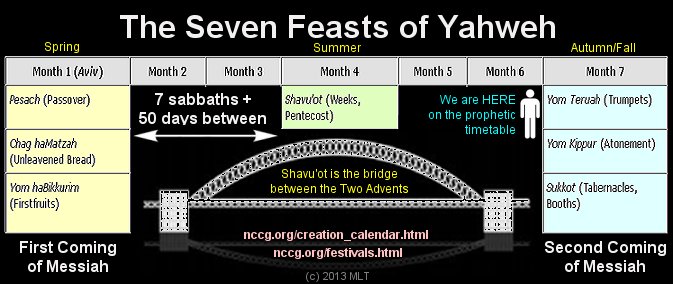 The Seven Annuel Feasts of Messianic Israel in perspective
The Day of Self-Weakening
There is a reason we come fasting today, called "self-affliction" or "self-weakening" ('anah) in Scripture (unlike all the other festivals which are times for feasting) and I would like to suggest to you that there is a very deep spiritual reason for this:
"In the seventh month, on the tenth day of the month, you shall afflict your souls, and do no work at all, whether a native of your own country or a stranger who dwells among you" (Lev.16:29-30, NKJV).
Dying to Self-Will
Regarded by many worshippers as the most holy or qadosh of all the moedim or appointments we have with Yahweh, I would like also to suggest to you that is is the most difficult moed to understand because everything it stands for runs 100 per cent in opposition to the disposition of our fallen, fleshy nature. It is one thing to die to self, as we must, to enter into that genuine relationship with Christ that is actual submission - and not just our intention to submit - as individuals, but dying together as a collective or coporate Body is, I think, about as remote to our carnal, fallen, Adamic, fleshy nature, with its incessant demands for its 'rights' and 'independence' as it is to our revulsion at the very idea of dying itself. For the Creator has placed within every living creature the will to survive and live, to cherish living over dying, to overcome even death itself. And yet to receive the Life - Eternal Life - requires relinquishing that deep instinct, trusting that something infinitely better is being offered to us in the Person of the Son of Elohim (God).
Touching the 'Other Life' - My Testimony
20 days ago, at a time when I knew I was hovering between life and death once again because of my age and illness, I reached a point that I have striven to arrive at all my life as a talmid or disciple of Christ. I touched, rather than fully embraced (if I am brutally honest with you), that 'other life' about which I have spoken so enthusiastically since 1977 when I was born again, not realising just how 'theoretical' I had been for the last 48 years in so many ways - not completely but in larger measure than I cared to admit.
Mistaking Verbal Intent for Actual Doing
We have, I have repeatedly learned in 'three score years and ten' (plus one), an enormous capacity to delude ourselves. We often attempt to spiritually 'speak' things into existence (a 'name it, and claim it' mentality) as a way of avoiding actually being spiritual. Dying to self is a lot harder than we imagine. Surrendering does not come 'naturally' or easily. And we often lazily (or out of naked fear) try to convince ourselves that it does come effortlessly by repeatedly speaking our intent in words, often mistaking the intent for the actual doing. This we do because we have not yet fully - if at all - grasped the meaning of the words we speak in prayer or sing in worship.
'Help Me to More Fully Yield to You'
There is a modern worship song, beautiful in its intent, which goes something like, 'Lord, I yield all to You.' Though the intent is noble, simply saying or singing out loud, 'I yield all to You', does not automatically mean we have actually yielded all to Him. And I think part of the delusion we can so easily get ourselves into in singing or praying such lyrics comes from the false occultic theology that we can speak reality into existence, a product of contemporary charismatic Christianity. Millions of Christians have been deceived into believing that their words are creative in the same way that Yahweh's Words at Creation brough the universe into being (Jn.1:1). Only Elohim (God) can create in that way. All we can do is ask for enablement through our faith in what He has already done and is doing now. A better prayer, then, would be, 'Help me to more fully yield to you, Lord.'
Shut Up, Flesh!
Fasting shuts the flesh up like no other spiritual discipline. We need to set two ideas in sharp contrast with one another: 'Lord, I believe' (which may, or may not be true) with 'Lord, help Thou my unbelief' which, to greater or lesser degrees, is always true. Little children believe a lot more readily than adults because they are more innocent and less encumbered by sin as a rule, and because the flesh has not seized them by the throats yet. They have not sinned as we adults have. I am not saying that we should not declare, 'I believe', only that we need to be sure we are both sincere and acknowledge that we desperately need that intent to be sustained supernaturally by the only One who can. For we can have faith one moment, and doubt the next, as we all know. Because the flesh nature resides in our physical bodies (don't ever confuse the two as the gnostics did, and still do), it will always be there to counter whatever faith we may choose to exercise, ever tripping us up if we listened to it and allow it to. Paul expressed his own frustration with the flesh, did he not, when he bewailed the fact that he kept on doing what he didn't want to do:
"We know that the Torah (Yaheh's Law, Teaching, Instruction) is spiritual; but I am unspiritual, sold as a slave to sin. I do not understand what I do. For what I want to do I do not do, but what I hate I do" (Rom.7:14-15, NIV).
So when we make that confession - "help Thou my unbelief" (Mk.9:24) - as we must all do at some point, then in doing do we are acknowledging that we have spiritual overcoming yet to do (1 Jn.5:45; Rev.2:7,11,17,26; 3:5,12,21; 21:7).
Honesty Precludes Self-Delusion
Now I am saying this not to discourage you but rather to ensure that you are brutally honest with yourself. We have to be if we are to avoid being deluded - worse, if Yahweh sends the delusion because you refused to love the truth (2 Thess.2:11). And to be an honest believer, you must become aware of the reality of your condition, something the flesh does not want you to be aware of because Satan wants you to remain, and get comfortable, in sin. For him, ignorance of your own condition is his victory because then he can be about convincing you that all is well in sinning.
Striking a Blow Against Pride & the Flesh
We have to be aware, first, that we do actually have to metaphorically crucify the carnal man and not simply pretend it isn't there. For it most certainly is. Admitting that is at once a blow to pride, and pride ist without a doubt arguably the greatest sin of all, or at its root lies the spirit of murder. It's what brought the Archangel (Heylel, Lucifer) down. There is a very real uncomfortable part of ourselves that we have to set aside in order to be able to live the spiritual life victoriously, successfully and joyfully. And whilst we cannot literally crucify or kill it while we live in this physical body (without killing ourselves, which is suicide, which is a very great sin indeed, for we are not given the right to murder ourselves), we can most definitely 'die to it', meaning, we can choose to ignore its incessant, demanding impulses to self-gratify. This is not at all easy, even though many Protestants try to make it out to be so by insisting that all you have to do is make a 'declaration' as though you were Elohim (God). We cannot declare this fallen nature's death in us and expect it to happen magically because of words and a bit of willpower because it doesn't work like that. That is bordering, as I said, on occultism, by the supposed ability to manipulate and control invisible forces. It's the supposedly 'Christian' was of casting spells and is an abomination. We can only declare our intent and resolve to our Heavenly Father and then ask (don't forget this part) to be supernaturally equipped to do so through His Son, Yah'shua (Jesus) and/or ask Him to work invisibly on our behalf. Our own willpower is never enough and we will be defeated again and again if we attempt using it unaided.
The 'Making-and-Breaking' Moed
Yom haKippurim is both a 'maker' and a 'breaker'. It makes, or justifies, those who have not presumtuously declared or implied that they have no overcoming to do, who live authentic lives of faith accompanied by repentance and the overcoming of the fallen flesh-nature, whose fruits of holiness and righteousness are evident in their love (the way they treat other people), in their emunah-faith and in their Torah way of life. They are do-ers or 'walkers rather than talkers'. They're not 'declaring' this or that but quitely, humbliy and without fanfare, getting on with their Kingdom service. They have no need to announce themselves with words.
Declaring Ones Humility?!
I learned this lesson early on when in my 20's for three years I lived among the Mormons. One thing that jarred my spirit was hearing the way so many of them prayed. 'We humbly ask (this or that)...' or '..I ask this in humility in the name of Jesus Christ.' Anyone who anounces their humility - that they're being humble - isn't humble. They want to be heard and labeled 'humble' by their peers. It's a projection of something they want you to acknowledge whether there is humility there or not. Flowery prayers do not impress our Heavenly Father and more often than not they are a sign of insincerity. He wants honesty, directness ,genuineness and simplicity. Would you ever speak like that to another human being? 'Dad, as your ever-so-humble son, I humbly ask you for more pocketmoney?' Dad knows whether you're being humble or not by the tone of your voice and the spiritual vibes you're emitting! So many of our prayers are actually saying things to others we wouldn't dare say to their face. It's like boasting how you became humble, which is an oxymoron (contradiction), is it not? It's frankly disgusting. Declared humility is by definition false humility and belong to immature, fleshy brats putting on a show.
Eastern Orthodoxy's 'Jesus Prayer'
The Eastern Orthodox have a tradition that I love. That's not to say individuals who follow it can't be insincere but if the intent is genuine, and we're not praying this to impress others, it is very powerful. It's known amongst them as the 'Jesus Prayer'. My Anglican chaplain at University College, Oxford, William Sykes, was a great believer in it. For him it was an expression of Psalm 4:4, "Commune with your own hearts on your beds and be silent" (RSV). Once a week for an hour in the evening, he and a student would meet in his room, draw the curtains (drapes), turn off the electric lights, and light a solitary candle on a table in front of them. They would each sit in an armchair close by, and meditate in silence on the 'Jesus Prayer' for an hour:
"Jesus Christ (Yah'shua the Messiah), Son of God (Elohim), have mercy on me, a sinner".
The Tax Collector & the Pharisee
This prayer is based on Luke 18:13 where you may remember a tax collector in prayer, beating his chest in genuine remorse, would cry out, "Elohim (God), have mercy on me, a sinner". This authentic act of humility and desperation the Saviour contrasted with an arrogant Pharisee boasting in his own works and superiority, who prayed:
"Elohim (God), I thank You that I am not like other men - robbers, evildoers, adulterers - or even like this tax collector. I fast twice a week and give a tenth of all I get" (Luke 18:11-12, NIV).
If ever you need a passage of scripture confirming that our works do not save us but rather a rightly-related heart to our Heavenly Father, this is it.
What of Being Perfect?
A word of warning. Others quote this incident, along with others, to 'prove' that we can never be perfect and shouldn't therefore even try. That too is false, else Yah'shua (Jesus) would never have have commanded us to do something which we actually could, for otherwise we would be sinners in perpetuity, and His blood of atonement would not be able to reach us because we could never be able to obey His mitzvot (commandments). For in a sermon He commanded, you will recall:
"Be perfect, therefore, as your heavenly Father is perfect" (Mt.5:48, NIV).
If You Want to Be Perfect...
There is nothing parabolic about this, for it's not as though this was the only instance. He said this also to the rich young ruler who was inordinately fond of his wealth, that was keeping him from entering the Kingdom of Heaven:
"If you want to be perfect, go, sell your possessions and give to the poor, and you will have treasure in heaven. Then come, follow Me" (Mt.19:21, NIV).
One Man's Idolatry Isn't Necessarily Another's
For this man to be perfect in accordance with the Master's command, he had to get rid of his idol, which for him was his large amount of money. Not that money is inherently idolatrous, for we all need that to get by in this world, but rather, as Paul taught:
"For the love of money is a root of all kinds of evil. Some people, eager for money, have wandered from the faith and pierced themselves with many griefs" (1 Tim.6:10, NIV).
and
"Keep your lives free from the love of money and be content with what you have" (Heb.13:5, NIV).
Good Works & the Heaven-Bound
What does that teach you about prosperity teachers and their followers and their insatiable lust after money? They are disqualified from the Kingdom of Heaven. Why? Because they do not seek the perfection demanded by Yah'shua (Jesus). At the same time, whilst, as a friend of mine once said, 'we are not saved by works but by faith alone, I have never known a man who was heaven-bound who did not do good works' - who was not overcoming the flesh, who was not Torah-obedient.
The Autumn Festival 'Temple' is Yet to Come
All of this concerns us as individual believers. But Yom haKippurim is not about individuals. Yom haKippurim is about the collective Body of Believers in Christ as a whole, for you will remember it is Yahweh and Yah'shua (Jesus) who are the Temple, and overcoming believers its pillars:
"I did not see a temple in the [holy] city (New Jerusalem), because the Yahweh-Elohim Almighty and the Lamb are its temple" (Rev.21:22, NIV).
"Him who overcomes I will make a pillar in the temple of my Elohim (God)" (Rev.3:11-12, NIV).
Two New Covenant Resurrection Temples That are Echad (One)
The New Covenant Temple in our future home in resurrection glory is not a building made of bricks or stone but Elohim (God) and the children of the first resurrection. Yes, Paul talks about our physical bodies being temples - multiple temples - of the Ruach (Spirit), and this is true of individual regenerated believers (1 Cor.3:16: 6:19) as represented by the three spring festivals, both in mortality now and later in immortality too. But there is another, greater, Temple consisting of the Father and the Son and the Bride of Christ (us). Thus there are two orders of 'temple', the one personal, and the other collective, the two together consisting of the whole Elohimhead (Godhead) and the elect, and one 'supra-temple', as it were.
Two Kingdoms of Resurrection Glory
That means we must learn Body-discipleship too. We must learn corporate life in Christ for there is a judgment on this future day of Yom haKippurim for the combined fellowship of those saved who live according to the tavnith or pattern of the Spring Festivals. And that is the difference between the first resurrection which occurs at the start of the Millennium and the second resurrection that starts at the end of it a thousand years later. That is the difference between the two kingdoms of glory which Paul compares in glory to the sun and the moon, respectively, because the first is a greater kingdom of obedience and the second is a lesser kingdom of disobedience. Both are 'saved' in the general sense, but to differing glories depending on what they did. As for the unsaved, they too are raised at the end of the millennium, in the second resurrection, hell having finally been emptied of them after a very, very long time, whence they will receive what is tantamount to no glory at all. For it is written:
"There is one glory of the sun, another glory of the moon, and another glory of the stars; for one star differs from another star in glory. So also is the resurrection of the dead" (1 Cor.15:41-42, NKJV).
The Three Catgories of Resurrection
What this means in practice is that at the final Yom haKippurim judgment of all takes place - the judgment of both the living and the dead - but the fate of the children of the second resurrection - the disobedient believers and the unbelievers - is postponed for a millennium, with the unbelievers having to wait even longer, we suppose. They remain where they are in Sheol, the place of the disembodied dead - in either the Paradise part (where the rest of the believers are located) or the Prison part (where the unbelievers and wicked are locked away) until the Thousand Year Reign of Christ on the earth is at an end, Satan is released one last time (to test those born during the Millennium) and is then forever bound in the Pit, never to be released again. At that point the disobedient believers are raised and receive their lesser reward which as we have seened is likened in brightness to that of the moon as viewed from the earth, and the unbelieving wicked are cast into hell (if they are not already there). There they will remain until the Cosmic Jubilee and Father is reconciled with the whole of His Creation in the Apocatastasis which in glory is rather dark, the only light there being no brighter than the twinkling stars in the night sky as viewed from earth at night, a marked contrast with both the moon (disobedient believers) and the sun (the obedient, overcoming believers - the Bride of Christ).
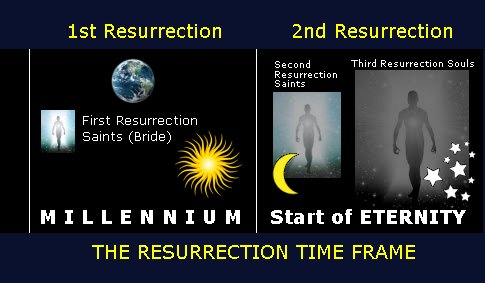 Father's Plan of Salvation for the Three Categories of Mankind
Learning to Walk in Body or Corporate Fellowship in Family Living
This, then, is a summary of our Heavenly Father's most excellent, gracious and simultaneously just Plan of Salvation. It is the Way of Yahweh, the complete way. Which brings us to the end-time Remnant which isn't just anybody claiming to be 'Christian' or 'Messianic', but to the overcomers who walk in Body union. How, then, are we to walk in this corporate way? We learn how to do this in family life - or ought to, if families are functioning as Yahweh intended them to. We do so, first, as children, and then as husbands and wives, which is the fullness, and then we have our own children, building our own families, unless it is our calling, like Jeremiah of old, to walk singly until the Day when we may have our own spouses and children in the Millennium.
Selfish Communities Atomise
It is no accident that Yah'shua (Jesus) depicts the relationship of the Millennial qodeshim (saints, set-apart or holy ones) as being like a collective wife - several wives, in fact (us), 'married' allegorically to Him. This is not a literal marriage, obviously, but resembles one in so many different ways. And we, as believers, must learn to get on together much as co-wives or sister-wives in those larger families we find mentioned in Scripture such as in the families of Abraham and David. (That is, why, incidentally, to answer a perplexing question I am sometimes ansked, why plural marriage (polygyny) is allowed in Scripture and never classified as a sin). And that, as the stories of those patriarchs and their wives who lived this way testify, is no simple matter, for we all make mistakes and sin, and tend to clash when we come to living in close proximity with one another. The fact that women and men are lumped together in this allegory is deliberate for we must all learn submission to Christ, even as wives learn submission to their husbands in righteousness. And that is not an easy thing either, for the inclincation of the fleshy nature is to rebel and do things our own way, independently. Indeed, the more selfish a society is, the more atomised it tends to become, as we are witnessing now in the postmodern West.
The United Order of All Things in Common in Jerusalem
To emphasise the importance of this forging of deep communal relationships in Christ as represented by Yom haKippurim and all three autumn festivals, we read in the Book of Acts about the very specdial way that the talmidim (disciples) lived in one particular congregation or assembly (church), the Central one in Jerusalem. What distinguished this apostolic congregation from all the others that are mentioned in the New Testament is that they pooled all their resourses together. We read:
"They (the Jerusalem fellowship, which included, as I mentioned, the apostles) devoted themselves to the apostles' teaching and to the fellowship, to the breaking of bread and to prayer. Everyone was filled with awe, and many wonders and miraculous signs were done by the apostles. All the believers were together and had everything in common. Selling their possessions and goods, they gave to anyone as he had need. Every day they continued to meet together... They broke bread in their homes and ate together with glad and sincere hearts, praising Elohim (God) and enjoying the favour of all the people" (Acts 2:42-47, NIV).
Importance of the Tithe for the Feasts
As you can see, they didn't just meet together on the Sabbath but every day for prayer and fellowship meals, weekly for the Master's (Lord's) Supper and annually for the six major festivals or feasts. Roughly 19 per cent of the tithe was devoted to these feasts when Yahweh's people were in the land, a third while in diaspora.
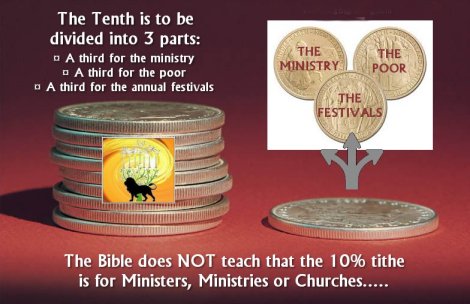
The Early Saints Loved Being Together
They met in one another's homes, in what we would call 'house fellowships' or 'house churches'. They just couldn't get enough of each other's fellowship because Christ was so powerfully among them, moving through the Ruach haQodesh (Holy Spirit). They lived what we call the United Order, having a common purse which was administered by the apostles. Not only was the love there overflowing but Torah-strictness was the vessel, as we learn in the tragic story of Ananaias and Saphira who attempted to cheat by breaking the financial rules. This was will be restored when the Final Gathering of the Twelve Tribes of Messianic Israel gets underway and 12 final apostles are called, one heading each of the regathered 12 tribles in their temporary separate locations. This means that in our day - or the day of the last generation - there will be the equivalent of 12 'Jerusalems' in diaspora preparatoty to the last gathering to the New Jerusalem at the beginning of the Millennium. This is the story of the Last Exodus which we have been anticipating and telling about for so long.
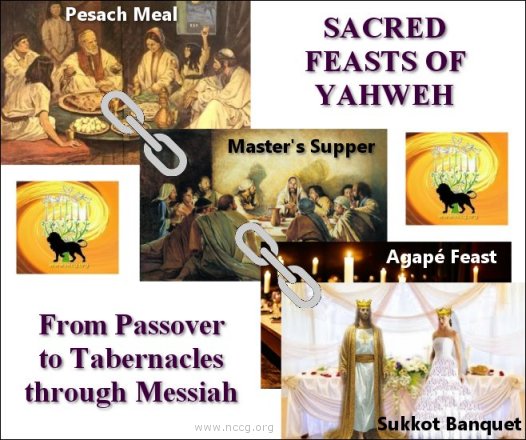 The Sacred Meals instituted by Heaven to prepare Yahweh's people for Heaven
Failed Attempts to Create United Orders
This is not an easy way to live. Many have tried and failed over the centuries. Ungodly men, pretending to be apostles, and unsanctified believers still governed by the flesh, have created hell instead of heaven. The cults are littered with many a disastrous communal experiment which has caused hurt and abused believers to understandably and rightly be extra-cautious in shying away from such projects. That, in part, is because there are no genuine apostles yet, and won't be until the final generation, but also because there is no real sense of corporate oneness or echad yet either, and that because believers are not willing to mutually sacrifice and overcome. Plus our increasingly divided and atomised cultures have been a great impediment. We ourselves have sought to effect a preliminary test gathering but without much success yet, though we have learned many vitally important lessons along the way that have contributed to our corpus of knowledge. Such projects cannot be undertaken having any hope of success without Yahweh's permission and acdequate advance spiritual preparation.
Looking Ahead to Sukkot
Do not seek to build such a fellowship like the early Jerusalem one before Yahweh's time. So long as men are attached to their money and women to either worldly ideas about coheadhip, Babylonian feminism and to worldly ideas about marriage in general, there can be no success in any final gathering. The festival of Sukkot or Tabernacles depicts how it is supposed to be, represented in the Book of Revelation as a Grand Supper - the Marriage Supper or Feast of the Lamb - which we will be celebrating in less than a week's time. This allegory depicts Christ as the righteous, loving Husband and Head, and we his polygamous bride (living selflessly in harmony together), feasting together (having all things in common), representing symbolically what the Millennium - and the first resurrection qodeshim (saints, set-apart ones) who inhabit it - will look like. Shemini Atseret, as I mentioned to you at Yom Teruah [1], or the Last Great Day of Sukkot, is simultaneously the first day of the Millennium.
Try the Yah'shua Prayer
We shall be fasting for the next 24 hours, from sunset to sunset, both so we can draw close to Father and also so we may gain a vision of just what the Remnant Bride of Christ is supposed to be like. May I suggest that you spent time in prayerful contemplation, as Bill Sykes used to do, for an hour on the 'Yah'shua or Jesus Prayer'? Try a darkened room with a lighted candle, and whether you gaze at the candle as Sykes did or close your eyes as his student did, just settle down, breathe slowly and regularly, making sure you stay awake, and listen to the Ruach (Spirit). If you can find someone else to share this with you, so much the better, for that is the congregational spirit of Yom haKippurim. Concentrate on the 12 words of that prayer and nothing else: "Yah'shua the Messiah (Jesus Christ), Son of Elohim (God), have mercy on me, a sinner", yielding yourself wholly to Him in acknowledgement of your weaknesses and struggles, and ask Him for His grace - His undeserved loving-kindness. For He is pursuing you in love, as Psalm 23 testifies:
"Surely [Your] goodness and love (mercy) will follow (pursue) me all the days of my life, and I will dwell in the house of Yahweh forever" (Ps.23:6, NIV).
Do this with your prayer partner or companion, do not speak to them. Ask for the spirit of Echadness or oneness - with Him and with whoever you are contemplating with. Let the Ruach (Spirit) effect all the communing.
Conclusion
This has been a very different kind of Yom haKippurim message this year and that is probably because this is a very different year to all the previous ones! I did this contemplation 20 days ago and this message today is what Father gave me the following morning. It is a message for the Remnant-saved, the childern of the first resurrection who want to be obedient in all things; it is for those who wish to fully surrender, to experience Elohim's (God's) vast love, as wide and deep as an ocean, and who want to walk in Father's presence always. Remember Psalm 23, for Yahweh is pursuing you even more vigorously than you are pursuing Him! All you have to do is be still long enough to let Him catch up with you. Have a blessed Yom haKippurim, until we will assemble here again tomorrow for the Neilah Prayers at the end of the moed (appointment), is my prayer in Yah'shua's (Jesus') Name. Amen.
Day #2 (1 October 2025)
THE Neilah Prayers
Introduction
Brethren and sisters, welcome back to the concluding session of this Yom haKippurim service where we present ourselves to Yahweh and ask Him for forgiveness for the sins of the past year so that we may collectively enter Sukkot next week with clean hearts. We pray this year not just for our own community but for the whole Body of Christ which continues to sin grievously in so many different ways.
More False Rapture Prophecies & the Idolatry of Nation-Worship
Yet another failed rapture prophecy, scheduled by some self-styled rapturist prophets, according to their erroneous calculations and false theological assumptions, to take place on 23 or 24 September this year (coinciding with the counterfeit Talmudic New Year called Rosh hsShanah) in place of the authentic Yom Teruah which took place on 22 September and the authentic New Year at Aviv 1 in the spring. There have been so many false 'rapture' prophecies now since 1948 that I have lost count of them. The problem is that so many are hurt when these predictions fail. The same with the sudden upsurge of 'Christian Nationalism' where counties have become idolised and mixed with the faith, that same sin of our Israelite forefathers, to them be used as a justification for waging unjust, imperialistic wars against other countries, leading to arrogance and pride. So let us pray, first on behalf of this community and second for the whole Body, as we remember these two major sins of the Body too:
The Concluding Neilah Prayers
O Yahweh, Elohim of our fathers! Let our prayers come before You, through Yah'shua our Deliverer, and do not hide Yourself from our supplication. What shall we say to You who dwell on High? You know all things, both hidden and revealed. You search our hearts and thoughts. Nothing is hidden from Your sight. We are not so arrogant nor hardened to say, 'We are righteous and have not sinned.' For truly we have sinned. We have turned away from the good mitzvot (commandments) You have given us. You are righteous and true in all Your ways, but we have done evil in Your sight. Thank You, our Heavenly Father, and Elohim of our fathers, that You forgive all our sins, pardon all our iniquities, sanctify the altar of our heart, bless and sanctify the quodesh (holy, set-apart) places in our homes and assemblies, sanctify your leaders in Messianic Israel, both the husband-fathers and the cohenim (priests) - the pastors and elders, and grant atonement for all our transgressions through the precious blood of Yah'shua the Messiah.
For it is written: "If we confess our sins, He is faithful and just to forgive us our sins and to cleanse us from all unrighteousness". 'Return O Israel to Yahweh-Elohim, for you have stumbled because of your iniquity. Take words with you and return to Yahweh. Say to Him, "Take away all iniquity, and receive us graciously, that we may present the fruit of our lips."'

We repent for the sin we committed in Your sight by:
- sinning wilfully, and for the sin we committed in ignorance.
- slander, and for the sin of lashon hara or gossip.
- neglecting our responsibilities, and for the sin of selfishness.
- indulging evil thoughts, and for the sin of lust.
- being lukewarm, and for the sin of not loving You with all our hearts and souls.
- not hungering and thirsting for righteousness, and for the sin of not being humble in spirit.
- not being merciful, and for the sin of withholding when we could have given.
- speaking foolish words, and for the sin of not controlling our tongues.
- not loving our neighbours, and for the sin of not blessing our enemies.
- not turning the other cheek, and for the sin of practising our righteousness before men.
- being proud, and for the sin of lack of zeal.
For the sin we committed in Your sight knowingly, and for the sin we committed unknowingly. For all these, O Elohim of forgiveness, forgive us, pardon us, and grant us atonement in Yah'shua the Messiah.
For the sin we committed in Your sight by:
- not walking as Yah'shua walked, and for the sin of not being filled with Your Ruach.
- loving the world, and for the sin of loving the things in the world.
- putting other things before You, and for the sin of idolatry.
- not praying at all times, and for the sin of not being thankful.
- not being quick to forgive, and for the sin of holding resentments.
- not going the second mile, and for the sin of impatience.
- not doing unto others as we would have them do unto us, and for the sin of greed.
- being anxious about the things of this life, and for the sin of not trusting You to provide for all of our needs.
- setting our minds on the things below, and for the sin of not setting our minds on things above.
For all these, O Elohim of forgiveness, forgive us, pardon us, and grant us atonement in Yah'shua the Messiah as your people Israel. Amen.
Shofar haGadol
(Final blowing of the ram's horn)
End Notes
[1] See Yom Teruah 2025: Joyful in Hope
 V494
V494

|