3
EMBLEM OF YAHWEH'S PRESENCE
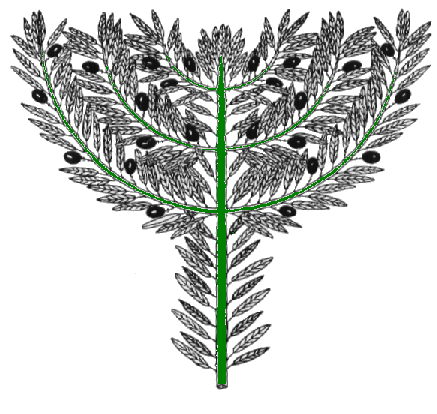
The Story of the B'rit Chadashah Logo
The seven-armed olive tree, shaped like a Hebrew menorah, was adopted as an official Messianic Evangelical logo of B'rit Chadashah on 6 April 1996 in Bergen, Norway. Though the olive tree and the menorah are common symbols in the Bible, whose meaning we shall examine in a moment, as a combined symbol it is utterly unique. And it came into existence in a unique way.
Revealed from Heaven
The story of the Messianic Evangelical Movement really goes back to 1984 when one of the six founders was led in prayer to begin a small congregation in his home town of Oxford, England known as the Restoration Christian Fellowship (RCF). Four years later he was similarly directed to relocate to Norway. There, together with others similarly led by the Ruach (Spirit) he built up two new congregations in Oslo and Bergen. Over a seven year period these two small groups, known as the New Covenant Christian Fellowship (NCCF), experienced great upheavals in 1992 and 1995 as they laboured to discern Elohim's (God's) plan for them and to align their lives to His will. By 6 April 1996 when NCCF (a precursor to the New Covenant Assemblies of Yahweh or NCAY) was formed, there were as many members left as had started in 1988, thus symbolising a new beginning.
NCAY is a Messianic-Evangelical Christian fellowship and ministry that believes in Yah'shua the Messiah (Jesus Christ) as the only hope for, and Saviour of, mankind. Like all Christian(Messianic groups it adheres to the Bible as the Davar Elohim (Word of God) and has as its foundational doctrine the Apostles' Creed. It stresses the importance of living a qadosh (holy, set-apart) life in obedience to the mitzvot (commandments) Yah'shua the Messiah (Jesus Christ) or New Covenenant Torah, and of being called as individuals and as a collective fellowship into a covenant relationship with Yahweh through Messiah. As in all covenants in both Old and New Testament times, any covenant must be:
- (1) initiated by Elohim (God);
- (2) accepted by man; and subsequently
- (3) ratified or confirmed by Yahweh, thus sealing it as a work of Elohim (God) and not of man.
The New Covenant Assemblies of Yahweh (NCAY), which is the result of many years of intense spiritual striving, is the third stage in a process begun in 1984.
NCAY is as different in appearance from the little group that started meeting together in 1986 as an oak tree is from an acorn or a butterfly from a caterpillar. As an acorn must die in the cold womb of the earth before it can emerge as a sapling, and as a caterpillar must be totally rearranged in the pupal stage before it can emerge as a winged butterfly, and as the people of Israel had to be refined in the desert of affliction on their way out of Egypt in order to be worthy to inherit the Promised Land, so also had the first Messianic Evangelicals (New Covenant Christians) to undergo tremendous inner purging, refinement and change in mind, heart and spirit.
The Vision
Though not properly born until 6 April 1996, NCAY was revealed symbolically in a vision on 31 December 1995 shortly after the fellowship had been substantially reduced in size by a mass defection of members. The fellowship had also been fiercely persecuted by opponents whose intention was to destroy it by discrediting its leaders publicly by bearing false witness. The surviving six members were therefore spiritually very low indeed and had spent much time supplicating Elohim (God) for direction at a time when all hope for the fellowship's future seemed to be lost. Yahweh then revealed His plan through an open vision to one of the six survivors, the founder:
"I had been awake for some time and had been supplicating Yahweh in prayer to reveal all that was wrong in my life so that I might more fully make teshuvah (repent) and be made right before Him, when a vision opened up before my eyes. I saw a Hebrew Menorah but it was not made of metal as one might expect. Rather, it was made up of freshly budding branches covered in masses of deep green olive-coloured leaves. The growth was so thick that it was sometimes difficult to distinguish the branches.
"The moment the vision closed I immediately became conscious of the fourth chapter of the Book of Zechariah which speaks of two gold menorahs and two olive trees. I opened my Bible and to my great astonishment read words that had direct application to our immediate needs and context:
"Not by might, not by power, but by My Ruach (Spirit), says Yahweh-Tsevaoth (the Lord of Hosts)...You will succeed because of My Ruach (Spirit), though you are few and weak. Therefore no mountain, however high, can stand before (you). For it will flatten out before (you). And (you) will finish building my temple [Community] with mighty shouts of thanksgiving for Elohim's (God's) mercy, declaring that all was done by Elohim's (God's) grace alone" (Zech.4:6,6b-7, Living Bible)."
This vision, together with the scriptural passage quoted, revived and spiritually invigorated the surviving six members and resulted in the formation of B'rit Chadashah three months later. It also confirmed a vision seen some months before in which the people, walking through a barren rocky valley with steep cliffs on either side, were then confronted by a vertical wall of rock in front of them which seemed impassable. The Spirit then lifted the leader up so that he could see behind the rocky wall, namely a giant reservoir of pure, fresh water, symbolising the Spirit waiting to be poured out.
A beautiful Ruach (Spirit) pervaded the conference held in Bergen 1-6 April 1996 that was characterised first and foremost by a deep inner shalom (peace), an unquenchable ahavah (love), and a sense of continuing mission. It was in this atmosphere that NCAY was born and it is very much this atmosphere that the logo of the seven olive-branched Menorah represents.
Symbology
Quite soon after the vision had been reported to the little fellowship it became clear that this living Menorah or candlestick represented living people. Supported by the central trunk which represents Yah'shua the messiah (Jesus Christ, the "vine") were the six surviving members (the "branches"). Yah'shua (Jesus) said:
"I am the true vine, and My Father is the gardener. He cuts off every branch in Me that bears no fruit, while every branch that does bear fruit He prunes so that it will be even more fruitful. You are already clean because of the Davar (Word) I have spoken to you, Remain in Me, and I will remain in you. No branch can bear fruit by itself; it must remain in the vine. Neither can you bear fruit unless you remain in Me. I am the vine; you are the branches. If a man remains in Me and I in him, he will bear much fruit; apart from Me you can do nothing" (John 15:1-7, NIV).
However, in the vision received, what was seen was not a vine tree but an olive tree, one of the most valuable trees of the ancient Hebrews. It is first mentioned in Genesis 8:11 when a dove returned to Noah's ark with an olive branch. Its virility and fruitfulness suggested to the Hebrew mind the ideal righteous man (Ps.52:8; Hos.14:6) whose offspring were described as "olive branches" (Ps.128:3). In the Book of Zechariah previously mentioned, the two olive trees were symbols of fruitfulness, indicating the abundance with which Elohim (God) had provided for human needs (Zech.4:3).
The fruit of the olive in its wild state is small and worthless, much as we, as human beings, are small and worthless without Messiah. To become prolific the olive must be grafted, a process by which good stock is made to grow upon the wild shrub. Paul uses this fact as a powerful allegory (Rom.11:17) in showing how the Gentiles are under obligation to the true Israel, indicating that it is contrary to nature for a wild olive slip to be grafted onto good stock.
We therefore see the necessity of the "wild", 'untamed' natural man to be:
- (a) grafted onto the True Vine (Yah'shua the Messiah/Jesus Christ); and
- (b) the Wild Olive Tree (the True Israel or the Body of Elohim's/God's New Covenant people)
in order to grow and prosper. By being grafted on to the Olive Tree, a man or woman can then partake of its oil by being fruitful in the Messianic Community (church, fellowship).
Olive oil is a very important biblical symbol. It was used at the consecration of cohenim (priests) (Ex.29:2) and in the anointing of kings (1 Sam.10:1; 1 Ki.1:39). The Messianic Evangelical or New Covenant Christian is also a cohen (priest) and melek (king) and is anointed by the oil of the Ruach (Spirit), for
"...you are a chosen people, a royal priesthood, a holy nation, a people belonging to Elohim (God)" (1 Pet.2:9, NIV).
The presence of olive oil symbolises gladness (Is.61:3) whilst its absence indicates sorrow or humiliation (Joel 1:10). It is used in the scriptures as an image of comfort, spiritual nourishment, and prosperity (Deut.33:24; Job 29:6; Ps.45:7).
The MENORAH was a seven-armed candlestick designed by Elohim (God) Himself for use in the tabernacle. Precise details of its construction are given:
"Make a lampstand of pure gold and hammer it out, base and shaft; its flowerlike cups, buds and blossoms shall be of one piece with it. Six branches are to extend from the sides of the lampstand -- three on one side and three on the other. Three cups shaped like almond flowers with buds and blossoms are to be on one branch, three on the next branch, and the same for all six branches extending from the lampstand. And on the lampstand there are to be four cups shaped like almond flowers with buds and blossoms. One bud shall be under the first pair of branches extending from the lampstand, a second bud under the second pair, and a third bud under the third pair -- six branches in all. The buds and branches shall all be of one piece with the lampstand, hammered out of pure gold.
"Then make its seven lamps and set them up on it so that they light the space in front of it. Its wick trimmers and trays are to be of pure gold. A talent of pure gold is to be used for the lampstand and all these accessories. See that you make them according to the pattern shown you on the mountain"
(Exodus 25:31-40, NIV).
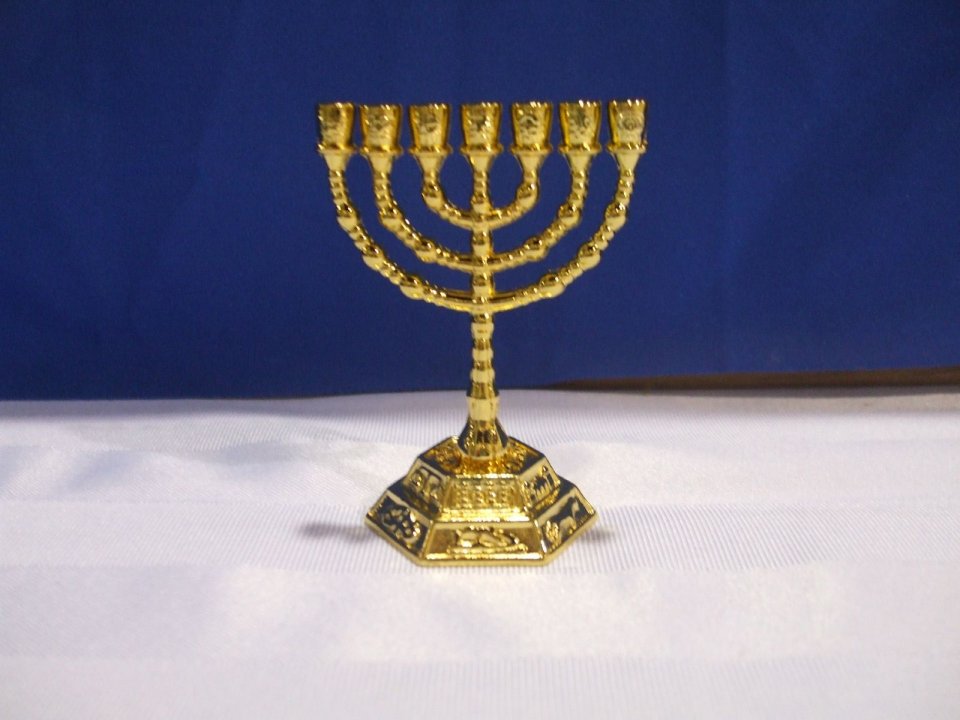
The Menorah design is pregnant with spiritual truth, far more than we can reveal in this short article. However, there are some salient points we ought to note carefully:
- (a) The flowers chosen by Yahweh were almond. Why? The clue lies in its Hebrew name, shaqed which literally means 'waker'. The almond tree was, further more, also the first tree to 'awake' in winter. Its blossoms are either pink or white, demonstrating an analogy with the hoary-headed Patriarch (Eccl.12:5), who is himself a symbol of the wisdom of age.
The prophet Jeremiah, who is the 'navi (prophet) of the B'rit Chadashah (New Covenant)' (Jer.31:31-34) was shown a vision of an almond tree at the beginning of his ministry (Jer.1:11-12) where there is a play on words in Hebrew (shaqed and shoqed) illustrating Yahweh's prompt fulfilment of His promises.
Therefore the almond flower means:
- (i) spiritual awakening;
- (ii) its fulfilment in the acquisition of wisdom; and
- (iii) the quick fulfilment of Yahweh's promises to His people.
The abundance of "buds and blossoms" in the carvings suggests that to be in Elohim (God) means a gradual spiritual unfoldment beginning with the bud and leading to the blossom and finally the fruit (the almond).
- (b) The whole design was engraved on a single piece of gold indicating that the buds and blossoms were a part of a whole unit. As we have seen, this fits perfectly with the picture we have seen earlier, namely, that Israel and the Messianic Community (Church) are one indivisible spiritual and temporal Body, just as the believer is a part of a wider Fellowship or Community (Church).
The Menorah is therefore, on one level, a depiction of God's People in union with Him. In the Old Covenant it was made of inorganic gold; in the New Covenant is a living organic being, of which the almond flowers engraved on the gold are a type. Candlesticks are designed to cast light just as a Christian is supposed to radiate the Light of Christ (Matt.5:16).
But why six branches and a central stem, making seven altogether? The number seven has a prominent place among sacred numbers in the scriptures, and is associated with completion, fulfilment, and perfection. In the story of the Creation Elohim (God) rested from His work on the seventh day, and sanctified it. This gave a tavnith (pattern) to the Hebrew Sabbath on which man was to refrain from work (Ex.20:10), to the Sh'mittah (Sabbatical Year) (Lev.25:2-6), and also to the Yovel or Year of Jubilee, which followed seven times seven years (Lev.25:8). Chag haMatzahor the Feast of Unleavened Bread and Sukkot or the Feast of Tabernacles lasted seven days (Ex.22:15,19; Num.29:12). Yom haKippurim or the Day of Atonements was in the seventh month (Lev.26:29), and seven occurs frequently in connection with Old Covenant ordinances and rituals, e.g. the sprinking of the bullock's blood seven times (Lev.4:6) and the burnt offering of seven lambs (Num.28:11); the cleansed leper was sprinkled seven times (Lev.14:7), and Naaman had to dip seven times in the Jordan to be healed (2 Ki.5:10).
The number seven saturates the scriptures in so many different ways: A loving daughter is preferable to seven sons (Ruth 4:15), the cohenim (priests) marched around Jericho seven times (Josh.6:4), Elijah's servant looked for rain seven times (1 Ki.18:43), and the psalmist praised Elohim (God) seven times a day (Ps.119:164). The apostle John addresses seven assemblies (churches) in Asia Minor in the book of Revelation where there is also mention of seven gold candelsticks, probably Menorahs (Rev.1:12), and seven gold stars (v.16); the miraculous feeding of the 4,000 from seven loaves and a few fishes (Mk.8:1-9), the seven basketsfuls collected afterwards, suggesting that Yah'shua (Jesus) can satisfy completely. The complete possession of Mary Magdalene is effected by seven demons (Lk.8:2) while the dragon of Revelation 12:3 and the beast of Revelation 13:1 & 17:7 has seven heads. Finally, the Millennial Paradise is depicted in terms of seven women united polygamously with one man (Isa.4:1). And one of the many translations of the first verse of the Bible says:
"The Almighty Elohim (God) of seven created all the judges and confirmed by mayim (water) the spiritual messenger of the B'rit (Covenant)" (Gen.1:1, Chavurat Bekorot trans.).
The message of seven is completion, fulfilment and perfection. According to ancient Christian/Messianic tradition there were, in addition to the quorum of Messiah's special emmissaries or apostles, another group of seven men and women, of whom Jesus was the first. Though the Messianic Scriptures (New Testament) openly reveal who the three men were -- John, James and Peter -- men who had a pre-eminient position within the Twelve and to whom Yah'shua (Jesus) shared sacred truths which He did not share with the other apostles (Matt.17:1; Mk.5:37; 9:2; 13:3,33; Lk.6:14; 8:51; 9:28; Gal.2:9) it only hints at the three women (Acts 1:14) whom tradition usually identifies as being Mary and Martha, the sisters of Lazarus (Jn.11:1,19-20), and Mary Magdalene (Matt.27:55-56,61; 28:1; Mk.16:19; Jn.20:18, etc.), whom Yah'shua (Jesus) drove the seven demons out of. All three had a very close association with Him.
The Formation of the New Covenant (B'rit Chadashah) Assemblies of Yahweh
Unlike the New Covenant Christian Fellowship which preceeded it, NCAY was not planned -- it simply 'happened'. When the 6 met together in Bergen, Norway, during the biblical New Year, a voluminous constitution was presented which had been written over the previous year containing the blueprint of a new organisation called the New Covenant Church of God (NCCG) or B'rit Chadashah Assemblies of Yahweh (NCAY) in Hebrew (the two names were later merged to form NCAY). It was not adopted until some years later. Revelation received later confirmed that the NCAY, whose symbol of a crowned rampant lion holding a scepter had previously been shown in vision many times, would arise naturally out at some future date.
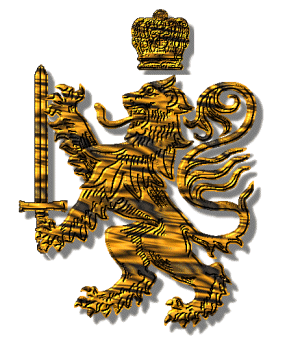 The NCAY Lion Logo (variant) - Copyright (c) NCAY
This occurred in 2001 when 32 churches in India requested membership and were formally admitted. Until that time Yahweh bound the six souls tightly together and represented them symbolically as a six-branched olive tree shaped like a Hebrew Menorah in a vision given at the end of the New Covenant's seventh anniversary in Norway during which it was celebrating all of Elohim's (God's) gifts to it.
NCAY was not an 'organisation' in the formal sense of the word for many years. In 2001 it began forming around New Covenant Ministries and is operated as a ministry and made itself available to whoever needed its services, whether in preaching, teaching, broadcasting, publishing or simply fellowshipping. It began serving the needs of Christian churches in Scandinavia and Eastern Europe and in 2001 organised the New Covenant House Fellowship, the experiences gleaned from which served as the basis the creation of workable structures for the admission probationary applicant congregations into full NCAY membership.
NCAY possesses a vast reservoir of experience and spiritual knowledge which it is willing to share with anyone willing to take responsibility for it. It began with six souls, two of whom have since died and two remain true to the original commission. Congregations have come and moved on in India and Africa (Kenya, Benin, Rwanda and South Africa), with membership peaking at around 3,000 in the first decade of the 21st century. All the while it has remained focussed on, and true to, its central calling which is the final gathering of the end-time Remnant. As a living organism, represented by the living Olive Menorah, NCAY will continue to change and be matured as Yahweh prepares it for its main mission. It is never idle and welcome all who desire to be grafted on to the central trunk, which is both the Master Yah'shua the Messiah (Jesus Christ) and the New Covenant Assemblies of Yahweh.
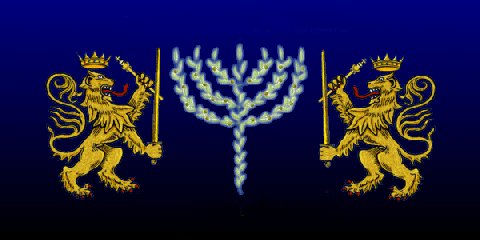 An Emblem of Mishpachah Lev-Tsiyon (MLT) Showing the Living Menorah
Return to Origins of NCAY

This page was created on 8 August 1997
Last updated 5 March 2017
Copyright © 1998-2017 NCAY - All Rights Reserved