The Sermon on the Mount:
The Beatitudes,
the Covenant of Salt
and the New Covenant Law
First Edition 12 June 1999, Second Edition 26 October 2015
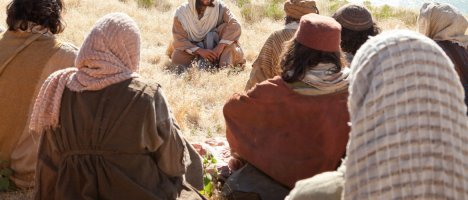

Introduction
The Sermon on the Mount is one of the most profound and deep spiritual teachings ever recorded by the pen of man and deserves, therefore, our closest attention and scrutiny for the life-saving principles it teaches. Because it is so deep there is infinitely more to it than at first meets the untrained eye and for this reason we shall not only be looking at three different English Bible versions of it (KJV, NIV, JNT) but also the Greek translation and, where available, the original Aramaic/Hebrew in which it was originally preached.
Types of Material in the Beatitudes
The Sermon on the Mount is the first of five great discourses in Matthew (ch. 5-7; 10; 13; 18; 24-25) and contains three types of material: (1) Beatitudes (declarations of blessedness) (5:1-12); (2) Ethical admonitions (5:13-20; 6:1-7:23); (3) Contrasts between Yah'shua's (Jesus') ethical teaching and Rabbinical Jewish legalistic traditions (5:12-48).
The Three Essential Ingredients of the Gospel
In this Yah'shua (Jesus) sets a pattern by informing us that the Way of the besorah (Gospel) involves:
- (1) Understanding and receiving Elohim's (God's) gifts of grace to us and the conditions for continuing to receive that grace;
- (2) Our response on the ethical front -- an expansion on the conditions of remaining in a state of grace; and
- (3) Showing us light by contrasting it with darkness, thus revealing to us why it is we were sent down to live in this world of sin with all of its heart-aches, contradictions and opportunity for spiritual growth.
The Basis of True Spiritual Authority
But there is more (as ever) -- the Sermon ends with a short parable stressing the importance of practicing what has been taught (7:24-27) and an expression of amazement by the crowds at the toqef (authority) with which Yah'shua (Jesus) spoke (7:28-29). It also reveals, therefore, what the basis of true spiritual toqef (authority) is -- not merely the external credentials Yah'shua (Jesus) bore as a regularly ordained Rabbi (by which He was authorised to preach in public with the blessing of the religious authorities of His day, despite being opposed by them later) but, far more importantly, the spiritual life and light (the Ruach haQodesh/Holy Spirit) that was in Him. The sublimity of these teachings attest more than anything else to His divine toqef (authority) before Elohim (God) and men.
A. The Beatitudes
3. Blessed are the poor in spirit: for theirs is the kingdom of heaven.
4. Blessed are they that mourn: for they shall be comforted.
5. Blessed are the meek: for they shall inherit the earth.
6. Blessed are they which do hunger and thirst after righteousness: for they shall be filled.
7. Blessed are the merciful: for they shall obtain mercy.
8. Blessed are the pure in heart: for they shall see Elohim (God).
9. Blessed are the peacemakers: for they shall be called the children of Elohim (God).
10. Blessed are they which are persecuted for righteousness' sake: for theirs is the kingdom of heaven.
11. Blessed are ye, when men shall revile you, and persecute you, and shall say all manner of evil against you falsely, for my sake.
12. Rejoice, and be exceeding glad: for great is your reward in heaven: for so persecuted they the nevi'im (prophets) which were before you.
(Matt.5:3-12; KJV)
Given for Disciples
In the preface to the Beatitudes (from the Latin, beatus, meaning 'blessedness', from Jerome's Latin version, the 'Vulgate' - 410 AD) we are told: "His disciples came unto him" (5:1). Before examining the Sermon we must understand to whom it was addressed -- not to unbelievers but to His "disciples". We must first understand, therefore, exactly what a "disciple" is. It is literally, "one who is under discipline" or a "follower of a religious leader".
Identifying a True Disciple
Important though this is concept of discipline is, on its own it smacks a little of the military which is why we need to return to the original Hebrew term, talmid (male disciple) or talmidah (female disciple) (JNT). "Disciple" fails to convey the richness of the relationship between a rabbi and his talmidim (disciples) in the first century A.D. Teachers like Yah'shua (Jesus) attracted followers who wholeheartedly gave themselves over to their teachers (though not in a mindless way as happens today in some cults). The essence of the relationship was one of trust in every area of living, and its goal was to make the talmid like his rabbi in knowledge, wisdom and ethical behaviour. Not only did the talmid learn facts, reasoning processes, and how to perform religious practices from his rabbi, but he regarded him as an example to be imitated in conduct and character (cp. Mt.10:24-25; Lk.6:40; Jn.13:13-15; 1 Cor.11:1). The rabbi, in turn, was considered responsible for his talmidim (Mt.12:2; Lk.19:39; Jn.17:12).
In Search of Apostolic Authority
Alas, this master-pupil, teacher-disciple relationship is almost completely absent from Christendom, largely because there is little true apostolic toqef (authority) on the earth despite the fact that many denominations ordain 'apostles' - Mormons and pentecostals/charismatics to name two. Thus there is considerable mistrust between modern 'teachers' and 'disciples', and with some justification, especially when these apostles let them down.
Four Types of Teacher, Four Modes of Scriptural Interpretation
There are three types of teacher ("rabbi") in the Messianic Evangelical Community: (1) Teacher-Deacons, whose responsiblity is to teach the literal written Davar (Word) in Scripture (p'shat), (2) Teacher-Elders, whose responsibility is to teach both the literal p'shat as well as the limited mesoteric remez mode, and (3) the Apostles, whose responsibility is to teach all the above plus mesoteric midrash, and the Patriarch-Apostles, esoteric sod) (see The Four Modes of Scriptural Interpretation). Yah'shua (Jesus), as "the Apostle and Cohen Gadol (High Priest)" (Heb.3:1, NIV) teaches all four modes in the Gospels.
Understanding Comes With Relationship
To appreciate the Sermon on the Mount requires appropriate discipleship -- it will not be fully understood by those who do not enjoy a true talmid relationship.
A Sermon Given Many Times?
Opinion differs as to whether the Sermon is a summary of what Yah'shua (Jesus) taught on one occasion or a compilation of teachings presented on numerous occasions. Some argue that Matthew possibly took a single sermon and expanded it with other relevent teachings of Yah'shua (Jesus). Thirty-four of the verses in Matthew's Sermon occur in contexts in Luke and other than the apparently parallel Sermon on the Plain (Lk.6:17-49).
An Integral Teaching
It is the opinion of this writer that Matthew's Sermon was delivered as recorded and used elsewhere by Luke, and that it should therefore be seen as an integrated whole. We base this on four major strands of thought:
- (1) Matthew (Mattiyahu) was an earlier talmid (disciple) of Yah'shua (Jesus) than Luke;
- (2) He wrote his Gospel in the original Aramaic/Hebrew;
- (3) The internal evidence of the Sermon suggests a deliberate structure designed to convey emet (truth) from the exoteric to the esoteric; and
- (4) The location, on a mountain, suggests a direct parallel with Mount Sinai on which the original Torah (Law) was given (cp. Luke's Sermon which was given on the plain).
The Standard for all True Believers
The Sermon on the Mount is Yahweh's call to His talmidim (disciples) to be perfect in the context of the New Covenant. It's moral and ethical standards are so high that some have dismissed it as being completely unrealistic or have projected its fulfilment to the future, Millennial Kingdom. There is no doubt, however, that Yah'shua (Jesus) (and Matthew) gave the sermon as a standard for all true Christian talmidim (disciples), realising that its demands cannot be met in our own power. It is also true that Yah'shua (Jesus) occasionally used hyperbole to make His point (see, for example, 5:29-30).
"And seeing the multitudes, He went up into a mountain.." (5:1, KJV).
The New Covenant Torah is Manifested in Graceful Living
The exact location is uncertain but it may have been the gently sloping hillside at the north-west corner of the Sea of Galilee, not far from K'far Nachum (Capernaum). The New Torah (Law), like the Old (Ex.19:3), was given from a mountain. But there is a difference, as the geography of the two locations suggests so vividly. The old Mount -- high, rugged, hot, parched, in the middle of a wilderness (and possibly with the salt-water Red Sea/Gulf of Aqaba in view) -- and the new Mount -- low, smooth, green, and overlooking the sparkling, tranqil fresh-water Sea of Galillee -- suggesive of even more simcha (joy) and shalom (peace) in the New Torah than the Old. In one word, Grace - Yahweh's undeserved loving kindness. Living the Torah is to be made considerably easier and more joyful in the Master of Grace, Yah'shua the Messiah (Jesus Christ), even though its exacting standards are every bit as difficult as the Old. Throughout His ministry Yah'shua (Jesus) emphasises that the Torah (Law) is not to be diluted or replaced, but brought to completion in Him. To live the New Law is only to be accomplished by living in Him.
All For His Sake
"....for My sake." (5:11, KJV)
"..because of Me" (NIV)
"..because you follow Me!" (JNT)
This short phrase is not an accidental insertion at the end of the Beatitudes but is a literary device linking all that preceeds it, making the Beatitudes a single statement. In other words, the different components are but parts of a whole, and we must never lose light of that whole if we are to obtain the full meaning.
Blessedness is the Theme of the Beatitudes
"(How) Blessed.." (KJV, NIV, JNT) is the Alef/Alpha theme word for the Beatitudes, just as "..for My Sake" is the Taw/Omega theme word:
"Blessed are ye...for My sake" (KJV)
"Blessed are you ...because of Me" (NIV)
"How blessed are you..because you follow Me!" (JNT)
is the 'whole' message of the Beatitudes -- everything else is but an amplification of the central message and cannot be seen apart from it. It is the vessel which 'holds' everything else. Thus any attempt to relate the teachings of the Beatitudes apart from Yah'shua (Jesus) is to pervert and/or falsify its meaning. (V.3 has, for example, been falsely used to justify a secular socialist political agenda).
Filled with the Divine Nature
The Greek word for "blessed" is makarioi which means "to be characterised by the quality of Elohim/God", in other words, to be filled with the divine nature. It corresponds to the Hebrew asher which means 'blessed', 'happy', and 'fortunate' all at once, so that a single English word is inadequate. Cp. Psalm 144:4, "How blessed/happy/fortunate the people whose Elohim (God) is Yahweh" Thus when one is indwelt by Elohim (God), and Elohim's (God's) nature is within him, he has the kingdom of Elohim (God) within him (Lk.17:21).
Fully Satisified
But "blessed" has a fourth meaning also, namely, "to be fully satisfied". This satisfaction is not, however, due to the circumstances of life nor the conditions prescribed in these Beatitudes, but due to Messiah's indwelling. Therefore is is misleading to translate makarioi as only 'happy', as some modern translations do (TEV, LB) because happiness is connected with luck (hap, from the verb 'happen'). People can be happy because of favourable circumstances, but they can only be blessed because of Messiah. It is an emotion often dependant on outward circumstances. Blessedness is that basic condition created by Messiah's indwelling in man's heart which brings a fundamental satisfaction in the life of a believer. It is an ultimate sense of well-being and the distinctive spiritual simcha (joy) of those who share in the salvation of the kingdom of Elohim (God), and can be present even when ones outward circumstances are anything but happy, such as in times of persecution (see v.11).
Blessedness as a Progression
Blessedness, however, is not static, but progressive. This progressiveness of blessedness depends upon the fulfilment of the conditions set down in the Beatitudes which follow, and our fulfilment of them is in fact the sign that we are blessed by Yah'shua (Jesus) or are merely pretending to be.
Poor vs. Helpless
The "poor in spirit" (Gk. ptóchos) -- the "poor" here indicates the helpless person contrasted to penés, which means 'poor but able to help oneself'. Thus the first step to spiritual blessedness is the realisation of one's spiritual helplessness. Thus the "poor in spirit" are those who have the humble, dependent, vunerable attitude of poor people, even if they happen to be rich, in contrast to the spiritually proud and self-sufficient.
Blessedness is Not Linked to Wealth
Yah'shua (Jesus) is not teaching, "Blessed are the financially poor", neither is He teaching, "Blessed are the ignorant", as some have erroneously interpreted this passage because of His teaching on the rich in the Sermon on the Plain (Lk.6:24). These Beatitudes were undoubtedly taught by Yah'shua (Jesus) many times to different people, and as was typical of Him, He modified and adapted His teachings to fit the circumstances. Whilst He most certainly teaches that wealth is an obstacle to spiritual blessedness because of the pride and attitude of self-sufficiency it usually generates (Mt.19:24; Mk.10:25; Lk.18:25) He never related physical poverty to blessedness.
Poverty and the Sermon on the Plain
This has caused some to misunderstand Lk.6:20: "Blessed be ye poor: for yours is the kingdom of Elohim (God)" (KJV); "Blessed are you who are poor.." (NIV); "How blessed are you poor" (JNT). Seen in the context of Matthew's Sermon on the Mount and in all his other teachings, Yah'shua (Jesus) can only possibly mean here: "Blessed are you who are poor if this leads you to be humble, dependent, and vunerable in spirit", bearing in mind that the vast majority of His listeners lived in abject physical poverty and lacked tiqveh (hope). What a contrast to the modern so-called 'Holy Spirit Movement' where material wealth is falsely associated with blessedness (the 'health and wealth' movement).
Not by Good Works
The kingdom is therefore more a gift than a recompense -- it is not something to be earned by good works, but the natural indwelling of the Ruach Elohim (God's Spirit) in those who are humble, dependent, sensitive and vunerable.
"Blessed are they that mourn: for they shall be comforted" (5:4, KJV).
Comfort for the Repentant Only
This does not, as many suppose, mean that Yahweh will comfort any and every kind of grief. "They that mourn" translates the Greek, hoi penthountes, which literally means sorrow for one's sins and the sins of others. In short, "Blessed are those who repent of their sins and feel empathy with those who are likewise struggling with sin."
Sing Your Sins Away?
What a contrast to the modern charismatic movement which in essence calls for people to 'sing and praise' their sorrows away! The true Besorah (Gospel) is one of balance: there is "..a time to weep and a time to laugh, a time to mourn and a time to dance.." (Eccl.3:4, NIV). There is no divfine comfort for those who refuse to make teshuvah or repent.
Meekness as a Disposition Toward Yahweh
"Blessed are the meek: for they shall inherit the earth (JNT, "the Land")" (5:5, KJV).
This Beatitude is taken from Psalm 37:11, "But the meek will inherit the land and enjoy great shalom (peace)" (NIV). The word "meek" (Eng. humble, patient, submissive) in Greek is a complex word. It refers not so much an attitude towards man as to a disposition before Elohim (God), namely, humility, though this will naturally reflect on our relationship with our fellow men.
The Gentle Component
The NASB renders the passage, "Blessed are the gentle.." which reflects another important quality of the man who is indwelt by the Ruach Elohim (God's Spirit). "The servant of Yahweh must not strive; but be gentle unto all men, apt to teach, patient" (2 Tim.2:24; KJV). "..speak evil of no man...but (be) gentle, shewing all meekness unto all men" (Tit.3:2, KJV). "..the wisdom that is from above is first pure, then peaceable, gentle, and easy to be intreated, full of mercy and good fruits, without partiality, and without hypocrisy" (Jas.3:17, KJV). "Servants, be subject to your masters with all fear; not only to the good and gentle, but also to the froward (harsh)" (1 Pet.2:18, KJV). Of the apostles, Paul says: "..we were gentle among you, like a mother caring for her little children" (1 Thes.2:7, NIV). Of Moses, who has been falsely caricatured as a harsh and cruel patriarch, Yahweh said: "Now the man Moses was very meek, above all the men which were upon the face of the earth" (Num.12:3, KJV).
Meekness is Not Passive Toward Sin
There is another side to meekness which cannot be ignored, however. It is derived from prautés, praos, or praus meaning, in this context, 'to become angry at sin'. It is the active attitude of the Christian toward sin in combatting it instead of a passive, indifferent attitude. Indeed, this is the only really satisfactory way of understanding the next Beatitude on "hungering and thirsting for righteousness" (see v.6). Indeed, we are to understand that the person who is not actively combatting sin is not truly humble towards Yahweh because he is not submitted to Yahweh's will.
Do the Meek Inherit the Land of Israel or the Whole Earth?
What about the inheritance of the meek? Is it the "whole earth" or just the 'Land of Israel'? Christians often think that since the Besorah (Gospel) is for all humanity, Yahweh is no longer interested in Israel as a nation (even though Mt.23:37-39 proves the opposite). This error, known variously as 'Replacement theology', 'Dominion theology', 'Kingdom Now thology', 'Covenant theology' (in some of its forms), 'Reconstructionism' and (in England) 'Restorationism' (nothing to do with Latter-day Saint or Campbellite theology), is so widespread now that New Testament passages are even mistranslated in conformance with it - see Romans 10:1-9, which is better rendered:
"Brothers, my heart's deepest desire and my prayer to God for Israel is for their salvation; for I can testify to their zeal for Elohim (God). But it is not based on correct understanding; for, since they are unaware of Elohim's (God's) way of making people righteous and instead seek to set up their own, they have not submitted themselves to Elohim's (God's) way of making people righteous. For the goal at which the Torah aims is the Messiah, who offers righteousness to everyone who trusts. For Moshe (Moses) writes about the righteousness grounded in the Torah that the person who does these things will attain life through them. Moreover, the righteousness grounded in trusting says: Do not say in your heart, 'Who will ascend to heaven?' -- that is, to bring the Messiah down -- or, 'Who will descend into Sh'ol?' - that is, to bring the Messiah up from the dead. What, then, does it say? 'The word is near you, in your mouth and in your heart' -- that is, the word about trust which we proclaim, namely, that if you acknowledge publically with your mouth that Yah'shua (Yeshua, Jesus) is Master (Lord) and trust in your heart that Elohim (God) raised him from the dead, you will be delivered" (Rom.10:1-9, JNT).
An Etymological Connundrum
The present verse (Mt.5:5) is one of those passages. Most Bible versions inform the reader that "the meek" (presumably all the meek from all the nations) "shall inherit the earth", ruling the entire planet. While believers will return to rule with Messiah at His Second Coming (1 Thes.4:13-18; Rev.20), here Yah'shua (Jesus) is quoting Psalm 37:11. Does, as many claim, the context limit "the meek" to the meek of Israel, who, according to Yahweh's promises, "will inherit the Land", the Land of Israel, which Matthew mentions explicitly in Matthew 2:20-21? Or is this only applicable in an Old Covenant context? And does the word rendered "land" or "earth" only have one possible meaning (the JNT, with its Zionist bias, insists it can only mean "the Land"), or is the meaning dual and dependant on its Covenant context?
The Changing Prophetic Face of Israel
An important distinction has to be made between the whole planet (earth) and the qodesh, set-apart or holy (promised) land first called 'Canaan' (later, under the Romans, 'Palestine') and then 'Israel'. The purpose of Yahweh's creation of the nation of Israel was to set a light or example amongst the pagan nations, calling the latter to repentance and into the national covenant. And whilst the divinely-marked real-estate called 'Israel' is seen in prophecy to most certainly continue into the Millennium as a distinct entitity, the rule of Messiah is not limited to that one territory but is global. There is an inheritance in the Land of Israel for all true Torah-obedient and Messiah-trusting believers, whether of natural Israelite descent or by grafting-in to its vine, that embraces all races, with Yah'shua (Jesus) reminding His talmidim (disciples) that the temple was not erected just for one bloodline but was to be "a house of prayer for all nations" (Mark 11:17, NIV). And indeed during the Millennium all nations shall come up to the New Jerusalem for the Israelite pilgrim feasts of Pesach (Passover), Shavu'ot (Weeks) and Sukkot (Tabernacles)(e.g. Zech.14:16,18-19). So what is the distinction between those who live in the Land of Israel in the Millennium and those who live in the other nations?
Who's Around in the Millennium?
The Scriptures make it plain that the unrepentant wicked do not inherit the Millennial earth - they are destroyed by the calamities that preceed the Second Coming. Moreover, Torah-disobedient believers, who do not belong to the first resurrection but to the second, do not inherit the Millennial earth either - they must remain as disembodied spirits in a parallel dimension until the final judgment assigns them their eternal habitation compared analogously by Paul to the lesser light of the moon (1 Cor.15:41). It is at this post-Millennial time that the disembodied spirits of the wicked are also finally judged to serve out their sentences until the reconciliation of the Cosmic Jubillee.
Gê and Aretz
The Greek gê and the Hebrew eretz can mean either "earth" or "land" so knowing how to translate these isn't always easy depending how far in the future you are projecting a particular prophecy, and in which particular prophetic cycle it applies. In Psalm 37 the Hebrew word eretz can mean "Land" or "earth"). Zionists, for the most part, believe that it must be traslated "land [of Israel]", that is to say, the Israeli Republic and certainly you could apply it there if you could prove the Israeli Republic is biblical Israel-restored. But is it? To understand why it cannot be, see the five-part series, Jacob's Trouble.
The New Jerusalem Inheritance
So, who (and when) are those 'of Israel' who "dwell in the Land" (v.3)? Who (and when) are those 'of Israel' who wait upon Yahweh (v.9), His way (v.34) who "inherit the Land"? And are they inheriting the Promised Land or the whole earth? Is it true to say that the term "inherit" in the Tanakh (Old Testament) usually refers to the Hebrew people's inheritance from Elohim (God), which includes, in addition to spiritual elements, not the whole earth but a specific small territory on the east shore of the Mediterranean Sea? And what about the New Jerusalem? We have an inheritance there too - a "mansion" (KJV, NKJV), "dwelling place" (NASB, OJB, NRSV), "staying place" (ISRV) "place" (JNT) or "room" (NIV, AENT, HRV) each, to be exact (Jn.14:2).
Which Prophetic Period of Time?
Eighteen times in the New Testament the Greek phrase ê gê can refer to the Land of Israel. As mentioned, two are explicit -- Matthew calls the Holy Land Eretz-Israel twice (Mt.2:20-21). Four are citations from the Tanakh (Old Testament) -- here (Ps.37:11), Matthew 24:30 and Revelation 1:7 (Zec.12:10,14) and Ephesians 6:3 (Dt.5:17). Five are based on the Tanakh (Old Testament) without being citations -- Luke 4:25 and Jame 5:17-18 (1 Ki.17:1; 18:1,41-45), Hebrews 11:9 (Gen.12,13,15,20,23) and Revelation 20:9 (Ez.38-39). The remaining eight may be implied by context -- Matthew 5:13; 10:34; 27:45; Mark 15:33; Luke 12:51; 21:23; 23:44; Revelation 11:10. But again, it all depends which of the five prophetic periods of time you are looking at - (a) Post-Patriarchal Old Covenant (Mosaic), (b-c) Pre-Millennial (Pre- or Post-Roman Expulsion), (d) Millennial or (e) Post-Millennial New Covenant.
The Versions Disagree
Thus the Jewish New Testament/Complete Jewish Bible (JNT/CJB) and the Aramaic English New Testament (AENT) translate Matthew 5:5 as "will inherit the land" and "will inherit the earth", respectively, and both cite Psalm 37:11 in support of their translation. Of other well-known messianic translations, which are usually all pro-Zionist, about half like the militarntly pro-Zionist Orthodox Jewish Bible (OJB), Restoration Scriptures True Names Edition (RSTNE) and Hebraic Roots Version (HRV) back up the JNT "land" with the rest, like the Institute for Scriptural Research Version (ISRV) and Messianic Renewed Covenant (MRC) supporting the traditional translation of "earth". Of the dozens of the Protestant and Catholic versions I know of, only the Catholic New American Bible (NAB), the Catholic Knox version, the Catholic Douay version, the Complete Bible by Smith & Goodspeed (S&G) and Concordant Literal New Testament (CLNT) support the "land" alternative. And the paraphrase, Good News Bible (GNB) mutilates the text entirely by saying, "Happy are those who are humble; they will receive what God has promised" (Mt.5:5, GNB) with the Living Bible (LB) not far behind, saying that "the whole wide world belongs to them" (LB).
Messianic and Non-Messianic Jewish Claims
For Zionistic Messianic Jews this becomes an issue regarding the claim of modern Jews to the Republic of Israel established in 1948 and so the political views of messianic translators in particular can cloud their judgment. The case is then made, by such as David Stern (author of the JNT/CJB), that all true Christians of all true nations will inherit the whole planet in the Millennium but that can only be secondary to the main meaning. Without the State of Israel, they claim, there can be no planetary inheritance, because Israel is to be at the centre of the Millennial Government, with Jerusalem the planetary (as well as Israel's) capital. The blessedness of the meek therefore has physical as well as a spiritual components AND THESE TWO MUST THEREFORE BE INSEPARABLE.
Three Instead of Twelve Divisions
But this interpretation rests on some major assumptions that cannot be true because Yah'shua (Jesus) makes clear that there are not two separate communites - Jews and Gentiles, messianic or not (Gal.3:28; Col.3:11) - because that wall of partition was abolished by the cross. The only 'division' is the natural one between all twelve tribes of Israel which not only must gather separately to the Holy Land but must receive their twelve separate tribal territories too. The Israeli Republic has only three divisions - Galilee, Samaria and Judea - which are a mix of Arabs, Jews (mostly of Turkic origin), Druze, Bedouin and others, making it look more like the former Roman provinces but with the former Judahite and Benjamite residents practically all gone. (See various articles on the tribes on our Israel website).
Return of the Twelve Tribes
It is at this point that we must point out the extreme danger of divorcing the Besorah (Gospel) of Yah'shua the Messiah (Jesus Christ) from its practical, outward physical aspect. Neither the Old nor the New Testament does it. Historically Christianity was 'stateless' (despite so-called "Christian states" which actually killed off the true Besorah (Gospel) from the time of Constantine onwards by politicising it after the fallen pattern of the world) from the time of the destruction of Jerusalem by the Romans. Today's Israelites - descended from Jacob who have accepted Messiah Yah'shua (Jesus) as their Deliverer (Saviour), Master (Lord), ISraelite King and Torah-Giver, along with those not of Israelite blood who have been grafted in - are that continuing state but for not without political borders. By the time the Second Exodus (which began in 2014) is concluded, all Twelve Tribes (Messianic Israelites) will be back in the Promised Land on time to receive the returning Messiah.
The Israeli Republic is Not Biblical Israel
The creation of the Republic of Israel in 1948 was not the restoration of biblical Israel. Why? Because it is not a theocracy and the bulk of its immigrants have any relationship to Abraham, Issac or Jacob. Worse, they have rejected the Messianic King of Israel which disqualifies them as Israelites - they follow the unredeemed, unsaved 'Jacob' rather than the saved, overcoming 'Israel'. If you reject a nation's legitimate king then you are not a part of that king's kingdom. You belong to another nation. The state in the Middle East should properly have been called the 'Jewish State', for that is what it is, not an Israelite state, not a Judahite state and most definitely not a Messianic state. It is not a theocracy but founded on the zionistic branch of communism - a secular state. Such religious elements as it does possess have nothing to do with the original Yahwist faith of the Tanakh (Old Testament) because its religion ('Judaism') is a mishmash of occultism (Kabbalah), Babylonian paganism and Talmudism.
A Counterfeit Nation
That is not to say that Yahweh has not have a purpose in the establishment of the Israeli State as He has for all nations but it is not the biblicallty prophesied re-establishment of the Nation of Israel in the end-times. It is a counterfeit. There are true believers within its boundaries - 'Messianic Jews' and 'Christians', all of whom have a calling and rôle in the current - though temporary - arrangement as prophecy concerning Edom plays itself out.
How It Will Happen
How, then, can Matthew 5:5 be fulfilled? If you can accept that the eretz is both the "land" and the "earth", and not just one or the other, then you will have a clearer picture of what Yah'shua (Jesus) was talking about. Certainly the Israeli Republic has not fulfilled this prophecy, even in part. The "land" part can only ever be fulfilled when the firstborn, remnant, overcoming, 144,000, Messiah-trusting and Torah-obedient to-be-gathered Twelve Tribes of Messianic Israel return there just before Yah'shua (Jesus) returns, and the "earth" part can only be fulfilled after Yah'shua (Jesus) returns after the nations have been judged and the survivors take their place in the New Order of Messiah.
The Final Gathering
The return to the "land" will not occur in a day. It took the Israelites of the First Exodus under Moses 40 years whilst paganism was burned out of them and a new generation was raised in all emet (truth). Before the great trek of the 12 Tribes back to the Promised Land can take place, they must first be gathered together into tribal units. This we call the Final Gathering. They have got to learn to live under theocratic rule and in the supernatural provision of the Most High. Before entering the Millennial Land of Israel they must have this theocratic system of government full restored. We speak of establishing twelve of these across the face of the earth where the groundwork of the practical as well as the spiritual Millennial Kingdom of Yahweh can be established. This is the only way that the blessing of the Third Beatitude can be fulfilled today. Indeed, it is the only way in which true meekness/gentleness/humility can be developed to perfection through the exposure and forgiveness of sin through Yah'shua (Jesus) our M;essiah. This work is already under way.
The Hungering Ones Pursuing Righteousness
"Blessed are they which do hunger and thirst after righteousness: for they shall be filled" (5:6, KJV).
This is very much connected with the preceeding verse which demands "active meekness". When a man exercises active combattiveness against sin, he hungers for a new filling of Yahweh's righteousness (Gk. dikaiosuné) which is the realisation of Yahweh's rightful expectation of the believer. "Which do hunger.." ("those who hunger" -- NIV, JNT) is the Greek present participle hoi peinónthes which is better rendered "the hungering ones", indicating constant and iterative satisfaction with Yahweh's righteousness, expending the received energy and hungering anew over and over as with physical hunger. Thus those who are just sitting back contentedly with what they have (or don't have) are missing out entirely on this blessing. There is a constant hungering and thirsting for more of Yahweh's righteousness.
Understanding Righteousness
What does the word "righteousness" mean? It means conformity to a standard of perfection -- holiness, justice and right-doing. When applied to a man, righteousness signifies the possession of the Christian virtues or fruits of emunah (faith), tiqveh (hope), shalom (peace) and ahavah (love), and generally a life which conforms to the divine Torah (Law) (Gen.15:6; 30:33; Mt.5:10,20). As with the previous Beatitude, this includes both the physical and spiritual domains. It implies not only individual righteousness but the righteousness of the Messianic community located in physical time and space in Eretz-Israel, for now in diaspora, the theocratic community (or for those without this blessing, a Church), for it is here that the individual and spiritual aspect will grow to perfection.
"And it will be righteousness for us if we are careful to observe all this commandment before Yahweh our Elohim (God), just as He commanded us" (Dt.6:25, NASB).
"..unless your righteousness surpasses that of the scribes and Pharisees, you shall not enter the kingdom of heaven" (Mt.5:20, NASB).
The Positive Response and Action of Righteousness
We are not here, of course, talking about legalistic obedience of the mitzvot (commandments) -- that is to say, obedience in order to be made right with Elohim (God) (for that is by emunah/faith only) as the Pharisees tried to do -- but of obedience out of ahavah (love) and a desire to please Yahweh for its own sake. Until there is a hunger and a thirst to be obedient to all of Yahweh's mitzvot (commandments) (the Torah/Law -- see v.17-18) the blessing of being filled with the Ruach haQodesh (Holy Spirit) CANNOT BE ACCOMPLISHED. We will be "filled" only in proportion to our obedience, and no more.
The Quality of Mercy
"Blessed are the merciful: for they shall obtain mercy" (5:7, KJV).
The outward demonstration of the Christian character is shown in "mercifulness" (Gk. eleos) which is to empathise with the unbeliever (as well as the struggling believer) and suffering with him the consequences of his sin and doing everything possible to relieve the tragic results. The difference between "grace" (charis) and eleos, is that the first affects the character of a person and changes it. Only Elohim (God) can show grace but we are admonished to show mercy and to be eleemones, "merciful", to alleviate the consequences of sin. "Be merciful, just as your Father is merciful" (Lk.6:36, NASB).
Holding Back From Punishing
To be merciful means to hold oneself back from punishing, or from causing suffering to, someone we have the right or power to punish. The blessing of being merciful is that we, in our turn, will be shown mercy back by Messiah:
"Forgive us our debts, as we forgive our debtors" (Mt.6:12, NIV).
Even When Not Reciprocated
Forgiving others does not mean that they will necessarily forgive us our wrong-doings to them (though if they are Christians/Messianics they ought to) any more than showing mercy to others will guarantee they will show mercy to us -- rather, Yahweh will forgive us for similar transgressions and show us mercy when we are deserving of punishment, though sometimes our goodness is reciprocated. But we must remember that this act of grace on our part must be viewed and carried out within the context of the other Beatitudes, namely, humility (as opposed to "buying someone off" in order to escape justice), gentleness, the quest for righteousness, etc..
Liberality and Generosity in Judgment
"Keep speaking and acting like people who will be judged by a Torah (Law) which gives freedom. For judgment will be without mercy toward one who doesn't show mercy; but mercy wins out over judgment" (Jas.2:12-13, JNT).
James tells us here that the believer is going to be judged (2 Cor.5:10). The judge is, of course, Yah'shua the Messiah (Jesus Christ). He is not going to be absolutely rigid. He is going to exercise liberality or generosity in many cases toward those who are judged. V.13 explains how the judgment is going to be determined:
"For the judgment is without mercy to him who did no mercy or showed no mercifulness" (Zodhiates trans.).
Judgment in Proportion to Generosity
Which explains Matthew 5:7:
"Blessed are the merciful ones, for they shall be shown mercy" (Ibid.).
The Judge's generosity toward the believer will be proportionate to the amount of mercy that the believer showed while on earth. If he showed no mercy, he will receive no mercy. The entrance into heaven is a result of the work which Christ alone did, yet the enjoyment of heaven and its rewards will be proportionate to what the believer did for Messiah in his life of faith on earth.
Consequences for Sinning
There are consequences for our willfil or unwillful sins on earth for which we may not have repented, or if we had repented, we may have been unable to provide restoration for the evil that we have caused. For these, according to Hebrews 10:26, there can be no future sacrifice on the part of Messiah. The consequences of our unrestored sinning on earth are compensated in proportion to the mercifulness we have shown while on earth. And then follows the last part of James 2:13 which literally translated says:
A Counter to Our Failures
This means that the believer whose life has been full of mercifulness will face the Judge unafraid because the Judge in His liberality will take into account the mercy that the believer demonstrated on earth as counteracting his failures and the consequences of his sin.
Purity of Heart
"Blessed are the pure in heart: for they shall see Elohim (God)" (5:8, KJV).
"Purity of heart" is not something that is achieved once and for all, but it is a continuous cleansing that the believer experiences as a result of the fulfilment of the previous conditions of blessedness. The more pure a person is, the more clear his sight of Yahweh comes:
"Everyone who has this hope in [Messiah] purifies himself, just as He is pure" (1 Jn.3:3, NIV).
"To the pure, all things are pure, but to those who are corrupted, nothing is pure. In fact, both their minds and consciences are corrupted" (Tit.1:15, NIV).
"If a man cleanses himself from (wickedness), he will be an instrument for noble purposes, made qadosh (holy), useful to the Master and prepared to do any good work. Flee the evil desires of youth, and pursue righteousness, emunah (faith), ahavah (love) and shalom (peace), along with those who call on Yahweh out of a pure heart" (2 Tim.2:21-22, NIV).
Pure in Your Whole Being
"..pure in heart" -- what is the "heart"? The heart, according to the Hebrews, is the centre of ones being, including the mind, will, courage, motivations, action and emotions -- "the well-spring of life" (Prov.4:23, NIV). "You have filled my heart with greater joy.." (Ps.4:7a, NIV). Thus a better translation might be: "Blessed are those who are pure in their whole being, for they shall know Elohim (God)" (cp. Jn.17:3). See Blessed are the Pure in Heart for a more detailed study.
Peacemaking in Perspective
"Blessed are the peacemakers: for they shall be called the children of Elohim (God)" (5:9, KJV).
This is another scriptural passage that has often been misused. "Peacemaking" is not simply trying to stop the feuding between nations and people (which might be argued to be its secondary meaning), but bringing the shalom (peace) of Elohim (God) that the believer has experienced to his fellow human beings (which is its primary meaning). As ever, we must consider if the peacemaking we are doing is bringing glory and honour to Yahweh or not.
Peace Settlments are not Peacemaking
In the Gulf War of 1991 'peace' was made with a tyrant before American public opinion forced a cessation of hostilities. The war ended in one way but in another the tyrant continued to oppress his people. Was a genuine peace made? In the same decade a 'peace settlement' was brokered between Israel and several Arab nations in exchange for land for the Palestinians. Terrorist actions continued. Was that peacemaking? What if the Allies had negociated a 'peace' with Hitler in 1943, offering a cessation of hostilities (and two years more slaughter) in exchange for Germany pulling out of the occupied territories? Would that have constituited 'peacemaking'?
Forced Peaces
These questions are difficult, if not impossible, to answer to the satisfaction of everyone because the spiritual element is missing. The true "peacemakers" are those who bring Elohim's (God's) shalom (peace) through Yah'shua the Messiah (Jesus Christ´) to repentant sinners. The Tanakh (Old Testament) prophesies of a time of world peace when the nations turn their swords into ploughshares but this is only the result of the mediation of the Ruach Elohim (Spirit of God). Clearly stopping war and killing has some value even if the spiritual conditions are not ideal; however, such a process cannot be justified from Matthew 5:9. A "forced peace", given time, can result in previously mortal enemies (like France and Germany) becoming friends...for a while. Forced peaces tend to eventually break down into unhappy pieces.
The 'Peace' Treaties Following World War I
It should be obvious that those who forced a peace settlement on Germany, Austria and Hungary in 1918 at the Treaties of Versailles, St.Germain and Trianon were not the "children of Elohim (God)". Their demands for impossible reparations showd no mercy (Mt.5:7) -- the purpose was revenge (see, for example, Understanding Compiègne. Arguably (and Hitler seized this to justify his own tyrrany) the "peacemakers" so-called sowed the seeds of resentment, bitterness and hartred of the Second World War.
Peacemaking is Reconciliation in Messiah
Forgiveness (the proper Christian reaction, despite the appalling losses), might have prevented the bloodshed and misery of 1939-45. Clearely not all 'peacemakers' are the "children of Elohim (God)" but only those who bring the reconciling love of Yah'shua the Messiah (Jesus Christ).
Persection for Righteousness' Sake
"Blessed are they which are persecuted for righteousness' sake: for theirs is the kingdom of heaven" (Mt.5:10, KJV).
"Persecution for righteousness' sake" causes a person to reach the highest rung of the satisfaction of blessedness, so much so that Yah'shua (Jesus) indicates that there is a double blessing by devoting two Beatitudes to it:
"Blessed are ye, when men shall revile you, and persecute you, and shall say all manner of evil against you falsely, for My sake" (5:11, KJV).
Mainly Inner Peace for Believers
Here, then, is evidence of the blessedness of the believer who is living his religion truly -- he will have little peace in the outside world because he will be hated and persecuted. Which is an appropriate footnote to the seventh beatitude on peacemakers, showing that the kind of shalom or "peace" made by Elohim's (God's) peacemakers is primarily (if not exclusively) inner shalom (peace).
Self-Denial and Suffering
"If we suffer, we shall also reign with Him: if we deny Him, He will also deny us" (2 Tim.2:11, KJV).
In the face of suffering, the Christian may resist or may exercise patience. If he does exercise patience, then he will reign together with Messiah. The believer's enjoyment in heaven will be enhanced proportionately to his patient endurance of suffering, sickness, and persecution in this life. He does have, however, the freedom to resist against the circumstances which Yahweh brings into his life which are not pleasant. If the believer denies Messiah on this earth in claiming that Elohim (God) is unjust in bringing upon him unwanted circumstances, then the Master will also deny him those rewards in heaven which he would otherwise deserve. This does not refer to a denial of entrance into heaven, even as the believer does not deny his faith, but only the privation of privileges and rewards even as the believer failed his Master on earth.
Living Another Gospel?
If the Christian is not being slandered, reviled, accused of evil, and generally being persecuted then it is possible that he is living another gospel to the one Yah'shua (Jesus) taught:
"Who shall separate us from the love of Messiah? Shall trouble or hardship or persecution or famine or nakedness or danger or sword?" (Rom.8:35, NIV).
The False Gospel of the Prosperity Movement
Clearly the 'health and wealth gospel', or the 'crown for a cross gospel' of the so-called 'Holy Spirit movement' has nothing to do with the doctrine of Messiah. It is a false gospel.
Heavenly Rewards
"Rejoice, and be exceeding glad: for great is your reward in heaven: for so persecuted they the prophets which were before you" (5:12, KJV).
When does this state of "blessedness" begin with the believer? It is not something to be experienced in the afterlife as the Greeks believed ("the eternal spring" of the Elysian fields), but it is something that begins the very moment that a person truely believes on, and surrenders to, Yah'shua the Messiah (Jesus Christ). This is demonstrated by the fact that the promise concerning the kingdom of heavens as in v.3 and v.10 is in the present tense whilst all the other promises are in the future. The fruits of one's obedience to the conditions of blessedness begin here, but they are not all given here. They will be given in their totality in the future, in heaven (v.12).
Our Fellowship With the Prophets of Old
"..for so persecuted they the nevi'im (prophets) which were before you" (5:12b, KJV).
Those who enjoy the blessedness of Messiah and His Torah (Law) as described in the Beatitudes will hold a natural fellowship with the nevi'im (prophets) from Tanakh (Old Testament) times. Indeed they will feel as comfortable in their company in the next world as they do with their Christian brethren in this one. Thus in closing the Beatitudes Yah'shua (Jesus) signals that the B'rit Chadashah (New Covenant) Torah is but a continuation and completion of the Old, as we shall see in vv.15-20.
B. Salt and Light
An Everlasting Covenant of Salt
There are many covenants described in the Bible, but I wonder how many Christians have heard of the Everlasting Covenant of Salt? Before we consider Yah'shua's (Jesus') continuing discourses we must understand exactly what this is:
"Whatever is set aside from the holy offerings the Israelites present to Yahweh I give to you and your sons and daughters (the Levitical Cohenim/Priests and their families) as your regular share. It is an everlasting b'rit (covenant) of salt before Yahweh both for you and your offspring" (Num.18:19, NIV).
"Don't you know that Yahweh, the Elohim (God) of Israel, has given kingship of Israel to David and his descendants forever by a b'rit (covenant) of salt?" (2 Chr.13:5, NIV).
Salt of the Earth
"You are the salt of the earth (JNT, "land"). But if the salt loses its saltiness, how can it be made salty again? It is no longer good for anything, except to be thrown out and trampled by men"(5:13, NIV).
Whom is Yah'shua (Jesus) addressing? Judean talmidim (disciples/believers). Therefore the Judean believers are the salt, a seasoning and a preservative. What are they preserving? The Land of Israel and the world (see v.5). They are seasoning for the Judean people, the "righteous remnant" (Rom.11). Elohim (God) established a "b'rit (covenant) of salt" (Num.18:19), which is applied to King David and his descendants -- that is, to the Messiah, Yah'shua the Messiah (Jesus Christ) (2 Chr.13:5). "..every one of you who does not renounce all that he has cannot be My talmid (disciple). Salt is excellent. But if even the salt becomes tasteless, what can be used to season it? It is fit neither for salt nor manure -- people throw it out. Those who have ears that can hear, let them hear!" (Lk.14:33-35, JNT).
Salty Obedience
Let us hear, then! Salt represents a person's willingness to do what Yah'shua (Jesus) demands of His talmmidim (disciples) (Lk.14:26-33). But if his willingness turns into unwillingness -- if a talmid (disciple) returns to worldly ways after experiencing the emet (truth) and simcha (joy) of following Elohim's (God's) way, what else is left to restore him? Nothing (see Heb.2:4-6).
From Boring into Interesting
Let us examine this more closely:
"Behave wisely towards outsiders, making full use of every opportunity -- let your conversation always be gracious and interesting, so that you will know how to respond to any particular individual" (Col.4:5-6, JNT).
The word "interesting" here literally means "seasoned with salt". The Davar Elohim (Word of God) should never be dull or boring to outsiders if it is taught in the proper way. Unfortunately, there are many Christians who are themselves "dull, tedious and boring" because they are not seasoned with salt.
Salt, Offerings and Covenants
What, then, is this mysterious "salt"? What is it that we should "hear with our ears" (Yah'shua/Jesus always uses this expression when He wishes to convey a hidden mystery)? In Leviticus 2:13 the salt that must accompany the grain offerings is called the "salt of the b'rit (covenant)" (NIV). According to Ezekiel 43:24, salt is also to be sprinkled on burnt offerings, and Exocus 30:35 specified salt as one of the ingredients in the special incense compounded for the sanctuary. A "covenant of salt" is an allusion to the salt used in the sacrificial meal that commonly accompanied the MAKING OF A B'RIT (COVENANT) (see Gen.31:54; Ex.24:5-11; Ps.50:5).
Becoming Salt of the Earth Through Faithful Covenant Obedience
Here the mystery is solved. Those who are the "salt of the earth" are those who have entered into binding covenants of Christian discipleship and are living them faithfully. But how can salt "lose its flavour"? And what does this mean?
Dead Sea Rock Salt
The ancient Hebrews had access to an unlimited supply of salt from a place today called Jebel Usdum, a 15 square mile elevation at the south-west corner of the Dead Sea, an area traditionally associated with the fate of Lot's wife (Gen.19:26). Such salt was of the rock or fossil variety, and, because of impurities and the occurrence of chemical changes, the outer layer was generally lacking in flavour. The reference in Matthew 5:13 is to this latter, much of which was discarded as worthless.
The Slow But Destructive Nature of Impurity
If the Christian allows impurities to enter his life then, like the salt at Jebel Usdum, he loses his spiritual flavour until he becomes worthless in the eyes of Elohim (God). The process is slow and therefore not usually observable until it is too late. However, if the outer layer is cut off, then the inner core of pure salt is still of value. The covenants of holiness are the salt, and the impurities are the sins which we permit to progressively destroy our spiritual life.
Fidelity and Constancy
Salt was often used amongst eastern peoples for ratifying agreements, so that salt becomes the symbol of fidelity and constancy. When Yah'shua (Jesus) calls His talmidim "salt" He is indicating that they have been true and faithful to their covenants, for which they will be blessed and inherit "the Land" -- Israel and the inner, Spiritual Land of the Kingdom of Elohim (God).
Preservative and Priestly Living Salt
Under the Old Covenant, salt was used in the Levitical cereal offerings (Lev.2:13) as a preservative to typify the eternal nature of the "covenant of salt" exisiting between Yahweh and Israel (Num.18:19; 2 Chr.13:5) as mediated by the Priesthood. In the B'rit Chadashah or New Covenant, all true believers are cohenim (priests) and are themselves individually, and collectively as a community, "living salt" abiding "living covenants".
The Salt That Sweetens
When Elisha used salt to sweeten the brackish waters of the Jericho spring (2 Ki.2:19-22), he was symbolically indicating that a Christian enters into new and everlasting chayim (life) only by entering into the covenants of the Messiah, Yah'shua the Messiah (Jesus Christ):
"I have healed this water [the sinner]. Never again will it cause death [because of sin] or make the land [the inner spiritual life] unproductive" (v.21).
The Wholesomeness of Salted Covenant
The water of the covenants remains wholesome to this day (v.22).
Personal and Collective Covenants
When Messianic Evangelicals speak of believers entering into personal and collective, communal covenants, most Christians react negatively because the idea is unfamiliar to them.
Negative Aspects of Salt
There is a negative side of salt too, for not only is salt (positively) a flavouring and preservative, thus typifying covenants, but it was negatively used in ancient Israel to deliberately destroy productive land (as at Shechem) by sowing it with salt (Judg.9:45) as a token of perpetual desolation, for salt renders land infertile (Dt.29:23). The "parched places in the wilderness" (Jer.17:6) were synonymous with a barren salt land (Job 39:6). Thus to willfully violate sacred covenants is to render the soul barren and infertile to spiritual growth, just as to enter covenants for the wrong motives (in order to be made right with Yahweh) without having first received the New Birth is as destructive as salt thrown on the land.
The Qumran City of Salt
The Qumran Community Settlement on the shores of the Salt Sea (known later as the 'Dead Sea'), near where the Dead Sea Scrolls (DSS) were found, was anciently known as 'îr hammelah, or the City of Salt. The Qumran colony was a strict pre-Christian covenant fellowship of Judahites, possibly of the Essene sect, who rejected the corrupt Priesthood in Jerusalem who did not belong to the legitimate Zadokian Priesthood line, and who were awaiting the coming of the Messiah. Many Essenes converted to Christianity before the remainder of the colony was destroyed by the Romans having first concealed their priceless scriptures in jars in local caves. Thanks to them we have the oldest Tanakh (Old Testament) manuscripts known. Much could be said about the Salt Sea and the City of Salt as these are replete with spiritual symbolism but this is beyond the scope of the present work.
The Nine Messianic Covenants
What are these Christian/Messianic covenants that believers are supposed to enter into? They are the covenants of holiness stated in the Beatitudes! And what are they?
- (1) To be humble, dependent, vunerable -- to be "poor in spirit" (Mt.5:3);
- (2) To "mourn" -- to be sorrowful for sin and repent immediately we commit them (5:4);
- (3) To be "meek" -- gentle, humble, and mild (5:5);
- (4) To "hunger and thirst after righteousness" -- to seek to obey the mitzvot (commandments) with all our hearts (5:6);
- (5) To be "merciful" -- to unconditionally forgive others of their wrong-doings to us (5:7);
- (6) To be "pure in heart" by pursuing a life of holiness or set-apartness (5:8);
- (7) To be "peacemakers" by bringing Yahweh's's shalom (peace) into others' lives through the Ruach (Spirit)that dwells in us (5:9);
- (8) To accept persecution, reviling and evil speech as a natural consequence of true discipleship (5:10-11); and
- (9) To "rejoice and be exceedingly glad" knowing that we shall have fellowship with the nevi'im (prophets) and patriarchs of old, and all those who have suffered for Messiah's sake (5:12).
What Does is Really Mean to Exercise Faith?
Most Christians are vaguely aware of the "New Covenant" though they often confuse it with the "New Testament" and have not usually considered what it means to enter the New Covenant except that they have some very generalised ideas about "having faith in Christ". They are, moreover, usually blinded by all the false theology that is in circulation about Israel, the Tanakh (Old Testament), the Torah (Law. Teaching) of Moses, etc.. But here we have Yah'shua (Jesus) teaching us just what He expects His talmidim (disciples) to do in order to be "interesting", "fruitful" and "spiritually productive".
Children of the Covenant of Holiness
We might perhaps re-translate Matthew 5:13 as follows:
"You are the children of the Covenant of Holiness (salt of the Land/theocratic community); but if you have broken your covenants of holiness (or, almost as bad, not entered into them at all) (if the salt has lost its flavour), how can you be made qadosh (holy, set-apart) again [made salty again]? You are no longer good for anything, except to be thrown out [of the covenant community] and trampled by men [being no use to yourselves or anyone else]."
What is a True Messianic Evangelical Disciple?
The taking of covenants, and faithfulness to them, is what gives New Covenant Christians or Messianic Evangelicals their "flavour" and it is what "preserves" them in times of persecution. Never has a New Covenant Christian or Messianic Evangelical who has been true to his covenants ever fled persecution or run away from the light:
"You are the light of the world. A city on a hill cannot be hidden. Neither do people light a lamp and put it under a bowl. Instead they put it on a stand, and it gives light to everyone in the house. In the same way, let your light shine before men, that they may see your good deeds and praise your Father in heaven" (5:14-16, NIV).
A Light for the Gentiles
This is a continuation of Yah'shua's (Jesus') teaching on salt. Of the Israelites Yahweh said:
"..I will also make you a light for the Gentiles, that you may bring My salvation to the ends of the earth" (Isa.49:6b, NIV).
From the Land of Israel into the Whole Earth
Just as the Israelites were supposed to be the "salt of the Land", so also are they also supposed to be the "light for the Gentiles." The Yahwist Faith, however, never encompassed the whole world, and this reference can only therefore refer to Christian or Messianic Hebrews and to those grafted into the Vine (Yah'shua/Jesus) together with them as Messianic Israelites. The 12 Apostles were all Christian Hebrews or Messianic Israelites. Paul, the Apostle to the Gentiles and a Messianic Benjamite, took the Besorah (Gospel) Light out of Eretz-Israel to Europe and Asia. It has since spread to Africa and America too and is now in the whole world. It has moved from the "land" to the "earth".
Adapting the Gospel to Local Customs
Unfortunately, the original Hebrew Christianity has become throughly Hellenised (combined with Greek culture; since then its has 'adapted' itself to nearly every culture in the world making Christian churches very unlike one another). Attempts by groups like Mormons and Jehovah's Witnesses have failed to restore the original Hebrew Christian Gospel but are usually variations of the cultures that spawned them (in the Mormon case, North American). The varieties of Christianity planted in Africa, for example, have usually been 'Europeanised' because of the European missionaries who founded them, but have now become 'Africanised'. Christianity which has spread itself in China has become 'Chinese', and so on. Many Christians view this polychromatic Church with favour and believe that Christianity should adapt itself to local cultures and customs.
The Apostacy
This is not, however, the teaching of Yah'shua (Jesus). Christianity/Messianism and the Land of Israel are essentially indivisible. When the original Messianic Community (Church) was driven out of Israel by the Romans, it quickly lost its Hebrew roots, became gentilised, and hostile to Torah, partly because of false apocryphal New Testament writings like the Epistle of Barnabas but mostly because of a political accommodation with paganism.
Incomplete and Diluted by Compromise
The main churches and denominations -- Catholic, Eastern Orthodox and Protestant -- are basically incomplete, muddy Gentile versions of the original Hebrew Besorah (Gospel). Fatally combining worldly politics with the Messianic Community (Church), the Besorah (Gospel) rapidly became corrupted. Today we see former 'Christian' nations actually returning to their natural, pagan and Helenistic roots.
The Division of Christianity Today
Not only is the Church becoming more and more separated from the secular state (as is right), but Christianity itself is dividing into two camps -- the one 'wordly Christianity' -- saltless and without light -- and the other, a small Remnant, slowly but surely moving in the direction of the original Hebrew Christianity/Messianism -- a Christianity struggling to find its Hebrew origins. The division is continuing as this commentary is being written -- a small part of Christendom is hungering and thirsting after the original Besorah (Gospel) of the Hebrew Apostles and not the polluted one which even now is dying. Unfortunately the seeking Christians do not always know quite what it is they are searching for -- they are not sure yet what the "salt" is though they are slowly beginning to find out by trial and error. It is at this juncture that Messianic Evangelicals have a message of hope, bringing as they do a restoration message and a fresh revelation for the 21st century.
C. Messiah's Teaching About the Torah
The Messianic Law Revealed
We have maintained that the Sermon of the Mount is a complete whole and not a collection of sayings from different times and places as Luke's Gospel is (Matthew was an eye-witness; Luke was not). We have already seen how the Beatitudes flow naturally into Yah'shua's (Jesus') "Salt and Light" Discourse. Now He speaks directly about what He has been hinting at all along -- that the Old Covenant Torah (Law) is about to be brought to completion (and not abolished, as false modern theology teaches).
"Don't think that I have come to abolish the Torah (Law) or the Nevi'im (Prophets). I have come not to abolish but to COMPLETE. Yes, indeed, I tell you that until heaven and earth pass away, not so much as a yud or a stroke will pass from the Torah -- not until everything that must happen has happened. So whoever disobeys the least of these mitzvot (commandments) and teaches others to do so will be called the least in the Kingdom of Heaven. But whoever obeys them and so teaches will be called great in the Kingdom of Heaven. For I tell you, unless your righteousness is far greater than that of the Torah-teachers (scribes) and P'rushim (Pharisees), you will certainly not enter the Kingdom of Heaven!" (Mt.5:17-20, JNT).
Messiah's Dismissal of Antinomianism
With six sentences, Yah'shua's (Jesus') dismisses all churches and denominations as "least in the Kingdom of Heaven" who say that the Law or Torah has been abolished or nailed to the cross by Messiah and who therefore do not seek to enthusiastically obey all of Yahweh's mitzvot (commandments). See What's Been Abolished? Understanding New Covenant Law and Cheirographon: Did Yahweh Wipe Out the Law?.
Torah as Teaching and Doctrine
The Hebrew word "Torah" means "teaching or doctrine" and is rendered in both the Septuagint (the Greek translation of the Tanakh/Old Testament) and in the New Testament by the Greek word nomos, which means "law". Greek has had a more direct and pervasive influence on English and other European languages than Hebrew has, and this is why in most languages one speaks of the "Law" of Moses rather than the "Teaching" of Moses. It is also part of the reason why the Torah has mistakenly come to be thought of by Christians as legalistic in character. See Romand 3:20 and Galatians 3:23 in European editions and compare these with the dunamic equivalent JNT/CJB version (and most other messianic translations) which renders the correct sense:
"For in His sight no one alive will be considered righteous on the ground of legalistic observance of Torah commands, because what Torah really does is show people how sinful they are" (Rom.3:20, JNT).
"Now before the time for this trusting faithfulness came, we were imprisoned in subjection to the system which results from perverting the Torah into legalism, kept under guard until this yet-to-come trusting faithfulness would be revealed" (Gal.3:22, JNT).
Judaism's Four Torah's
In Judaism the word "Torah" may mean one of four different things which we must carefully distinguish because only the first two are scriptural:
- (1) Chumash (the Pentateuch, the five books of Moses); or
- (2) That plus the Nevi'im (Prophets) and the Kethuvim (Writings), i.e. the Tanakh (known by Christians as the Old Testament -- see Mt.4:4-10);
- (3) That plus the 'Oral Torah', which includes the Talmud and other legal materials; or
- (4) That plus all religious instructions from the rabbis, including ethical and aggadic (homiletical) materials.
Here it means the first of these, since "the Nevi'im (Prophets)" are mentioned separately.
Defining New Covenant Torah
What, then, is the Messianic or Christian Torah? It is a threefold historical unfolding starying with:
- (1) The Pentateuch (first five books of Moses); to which was added the Nevi'im (Prophets) and Kethuvim (Writings) making,
- (2) The Tanakh (Old Testament); to which was added the Messianic Scriptures or New Testament making,
- (3) The whole Bible -- 'Old' and 'New Testaments' -- from Genesis to Revelation (Protestant Canon)
Completing the Torah Through Yah'shua
Though in this context Yah'shua (Jesus) is referring to the Pentateuch, His inclusion of "the Nevi'im (Prophets)" (with a capitalised P) (as in Mt.7:12; 22:40; Lk.16:16,28,31; 24:44; Jn.1:45; 6:45; Ac.13:15,27,40; 15:15; 24:14; 28:23; Rom.3:21), refers to the second of the three main parts of the Tanakh (Old Testament). When the Tanakh nevi'im (prophets) as persons are referred to, the word is not capitalised; "navi (prophet)" in the singular sense is never capitalised. By mentioning both the Torah and the Nevi'im (Prophets) Yah'shua (Jesus) is saying that He has not come to modify or replace the Davar Elohim (God's Word), the Tanakh (Old Testament) -- cp. Lk.24:44-45. Rather, He has come to complete it.
How the Church Wrongly Understands What Israel Is or Was
The Greek word for "to complete" is plêrôsai, literally, "to fill"; the usual rendering in European Bibles here is "to fulfill" (see ASV, KJV, NIV, RSV, LB; TEV/GNB has, "make their teachings come true"; but S&G & RBV have the correct sense, "to complete"). Replacement theology, which wrongly teaches that the 'Church' has replaced Israel as Yahweh's's people (see commentary on Mt.5:5), understands this verse wrongly in two ways:
- (1) Yah'shua's (Jesus') "fulfilling" the Torah is thought to mean that it is unnecessary for people to fulfill it now. But there is no logic to the proposition that Yah'shua's (Jesus') obeying the Torah does away with our need to obey it. In fact Paul, whose object in his letter to the Romans is to foster "the obedience that comes from trusting" in Yah'shua (Jesus), teaches that such trusting does not abolish Torah but confirms it (Rom.1:5; 3:31, JNT);
- (2) With identical lack of logic, Yah'shua's (Jesus') "fulfilling" the Nevi'im (Prophets) is thought to imply that no prophecies from the Tanakh (Old Testament) remain for those of literal Israelite descend (usually mistaken to be modern 'Jews'). But the Hebrew Bible's promises to those of literal Israelite descent are not abolished in the name of being "fulfilled in Jesus". Rather, fulfillment in Yah'shua (Jesus) is an added assurance that everything Elohim (God) has promised the Israelites will yet come to pass (see 2 Cor.1:20).
How Messianic Jews Wrongly Understand What an Israelite or a 'Jew' Is
But the orthodox Christian churches are not alone in making errors in such matters. A parallel error exists amongst those calling themselves 'Jews' who have received the Messiah Yah'shua (Jesus). Though there are different positions amongst 'Messianic Jews', all are more or less agreed that there are two different kinds of believer - Jewish believers, who are obligated to obey the Torah (and more often than not, much Pharisaic/Rabbinical/Talmudic tradition too) and 'Gentile' believers ('Christians') who are not. It is believed by them that the Jews represent all the twelve tribes of Israel to whom alone belongs the right to live in the Holy Land ('Israel', 'Palestine').
The Other 'Messianics'
A minority of 'Two House' Messianic Jews, who call themselves 'Messianic Israelites', believe that the modern Jew is 'Judah' (with Benjamin) and 'Christians' (the 'Church') are 'Ephraim'(with the other nine tribes). Some of these believe that 'Ephraim' will have the right to settle in the Holy Land but there are others who do not. Some of the more radical Messianic Jews believe that 'Christians' must convert to becoming Messianic Jews. But in all of these groups, influenced to some degree by Talmudic/Rabbinical thinking (which is hostile to 'Gentiles') there is the prideful and fleshy belief - openly proclaimed, or more commonly just implied - that Messianics of Jewish origin are a tier above those who are mere 'Gentiles' by virtue of the fromer supposedly being "the apple of [Yahweh's] eye" (Deut 32:10, NIV - also Ps.17:8; Prov.7:2; Zech.2:8) on account of their claimed descent from Abraham, Isaac and Jacob.
Messianic Evangelicals and the Wall of Partition
The position of Messianic Evangelicals and that of Scripture is that such divisions, partitions or barriers that once existed between Israelites and Gentiles, have been wholly abolished in Messiah Yah'shua (Jesus). All believers are now one People (Israelites) bearing one Name (Messiah Yah'shua/Jesus) and are citizens of one [Messianic] Israelite nation, currently in diaspora amongst the nations. Those converts not of Israelite blood by descent are automatically grafted into Israel (Rom.11) and become Israelites by virtue of their pledge of loyalty to the King of Israel (Yah'shua/Jesus) and their obedience to Israel's laws, namely, New Covenant Torah. Once spiritual regenerated (born again) and submitted to Torah, a convert's racial background becomes irrelevent. Indeed, the gene pool is now so mixed that there is a remote chance of someone of any race not having an Israelite blood connection, making racial origin even more irrelevent to the Besorah (Gospel). This is also true of 'Jewish' blood connections. Most every living soul has Israelite (Abrahamic/Jacobite) and Jewish (Khazar) genetic connections.
Messianic Jews and Messianic Greeks?
This means that there is no such thing as a 'Messianic Jew' or a 'Messianic Gentile' in the B'rit Chadashah (New Covenant). If there is "neither Judahite (Jew) nor Greek" because we are "all echad (one) in Messiah Yah'shua (Jesus)" (Gal.3:28, NIV) then there is no such thing as a 'Messianic Jew' or a 'Messianic Greek' (or 'Messianic Gentile') either. Rather, "if you belong to Messiah, then you are Abraham's seed, and heirs according to the promise" (Gal.3:29, NIV).
The True Origin of New Covenant Torah-Obedience
When we call ourselves "messianic", this is what we are - or should be - proclaiming though the term 'messianic' has acquired the added sense of being 'Torah-obedient' to separate or distinguish it from 'Christian' (which is allegedly anti-Torah). As Messianic Evangelicals we, like Paul, make no such distinction - for us, to be 'Messianic', is to be a spiritually regenerated follower or talmid (disciple) of Messiah Yah'shua (Jesus) and a Torah- or Law-abiding citizen of Messianic Israel. We are 'Evangelical' to underline the important doctrine that we are saved by emunah (faith, trusting) alone and not by any deeds or works (which is legalism and is wrong). Our Torah-obedience stems from our saved-ness and is not an attempt to be saved even if there are some of those calling themselves messianics who are legalists...like many 'Christians' too who believe salvation can only be obtained by being a member of a particular Church (Mormons, Catholics, Eastern Orthodox, Jehovah's Witnesses, etc.) or by adhering to a man-made creed or denomination. Legalism is potentially the bane or curse of all believers if they are not careful.
Where Messianics and Christians are Agreed
It is accepted by all believers - Messianic and Christian - that Yah'shua (Jesus) kept the Torah perfectly and fulfilled predictions of the Nevi'im (Prophets), but that is not the point of contention between Messianics and Christians. Yah'shua (Jesus) did not come to abolish but "to make full" (plêrôsai) the meaning of what the Torah and the ethical demands of the Nevi'im (Prophets) require. Thus he came to complete our understanding of the Torah and the Nevi'im (Prophets), so that we can try more effectively to be and do what they say to be and do.
Three Ways and Six Cases Showing the Necessity of Torah-Obedience
Matthew 5:18-20 enunciates three ways in which the Torah and the Nevi'im (Prophets) remain necessary, applicable and in force. The remainder of Chapter 5 gives six specific cases in which Yah'shua (Jesus) explains the fuller spiritual meaning of points in the Israelite Law. In fact, this verse states the theme and the agenda of the entire Sermon on the Mount, in which Yah'shua (Jesus) completes, makes fuller, the understanding of His talmidim (disciples) concerning the Torah and the Nevi'im (Prophets), so that they can more fully express what being Elohim's (God's) people is all about.
Perfecting a Foundation on Which to Build Further
The Anglican (Church of England) Christian writer Brigid Younghuges supports this understanding:
"'...I came not to destroy, but to fulfil.' And surely 'to fulfil' means to complete, in the sense of bringing to perfection, not, as Christians have all too often interpreted it, to render obsolete; to fulfil in such a way as to perfect a foundation on which to build further" (Christianity's Jewish Heritage, West Sussex: Angel Press, 1988, p.8).
Amen!
As if to underline His point, Yah'shua (Jesus) then says: "Yes indeed!" Except at the end of prayers, "Yes indeed" (NIV, "I tell you the truth", KJV, "For verily, verily I say unto you") and "Yes" may be used to render the Greek amên (which transliterates the Hebrew 'amen). The Hebrew root '-m-n means "emet (truth), faithfulness", which is why the Hebrew word 'amen means "It is true, so be it, may it become true" -- hence its use in English as well as Hebrew by those listening to a prayer. A speaker's "Amen" to his own prayer is itself superfluous, yet useful as a cue to others to respond with "Amen" (see Mt.6:13; Rom.1:25; 9:5; 11:36).
Amen is Far Bigger Than You Thought
In any case, Hebrew 'amen is always used in reference to something previously said. But most versions translate it as if it pointed forward rather than back! Thus to be specific, Yah'shua's (Jesuss) "Amen" to Hismelf emphasises His own previous point, sometimes with the force, "You may not think that I really meant what I said, but I do!" (Mt.5:26; 6:2,5,16; 10:15,42; 13:17; 18:18; 23:36; 24:34,47; 26:13). His "Amen" to what someone else has said can be acknowledgement conveying the sense, "I recognise the problem" (Mt.19:28) or even ironic in tone, "Your question/answer shows me that at last you're beginning to catch on!" (Mt.21:21,31), "You can't be serious!" (Mt.25:12) or "How I wish it were so (but it isn't)!" (Mt.26:34). Sometimes after a speech, or even after an event, it calls attention to what just happened, conveying things like, "That was amazing! Did you notice?" (Mt.8:10) or, "Not what you expected, is it?" (a beautiful example at Mt.18:3); at Mt.19:23 it amounts to a sigh; at Mt.25:40,45 the King's "Amen" means, "You are astounded that things are working out this way, but that's how it is"; at Mt.26:21 Jesus' "Amen" means, "Right now you are relaxed and comfortable, but I have news for you!". And sometimes Yah'shua's (Jesus') "Amen" is simply affirmative ("I agree") but becomes the take-off for His own reinforcing or contrasting remarks (several of the above examples, and Mt.8:13, where His "Amen" means, "I agree with your unspoken answer to my rhetorcal question"). See also Revelation 7:11-12.
D. Conclusion
Protestant Fears of Legalism Led to Antinominism
We see, then in these first 20 verses of the Sermon on the Mount, a condensed introduction to the Besorah (Gospel) of Yah'shua the Messiah (Jesus Christ). Looking backwards (since Yah'shua's/Jesus' "Amen" not only embraces what He said about the Torah ("Law") but the Beatitudes as well), we get a clear picture of a Besorah (Gospel) which has been almost completely lost from Gentile Christendom. Since the Reformers we have been told that the Torah or Tanakh (Old Testament) Teaching (Law) has been "fulfilled" -- abolished -- in Christ, and that all we must do is live by faith. But Yah'shua (Jesus) definitely contradicts such a position by adding, "You may not think that I really meant what I just said about the Torah, but I do!" For centuries Protestants have not believed and have tried to dismiss Yah'shua's (Jesus') sayings because they were afraid of creating another legalistic perversion like the Roman Catholic one they had just cast off. Their fear was understandable but not justified.
The True Meaning of 'Works of the Law' and 'Under the Law'
For too long the children of the Reformation have been putting all their hope on such falsely translated passages as Galatians 2:16a which in modern versions reads: "We who are Jews by birth know that a man is not justified by observing the law, but by faith in Jesus Christ" (NIV) when it ought to read:
"We are Judeans by birth, not so-called 'Goyishe (Gentile) sinners'; even so, we have come to realise that a person is not declared righteous by Elohim (God) on the ground of his legalistic observance of Torah commands, but through Messiah Yah'shua's (Christ Jesus') trusting faithfulness.." (Gal.2:15-16a, JNT).
Or as another translation puts it more literally:
"For if we who have a Judahite nature ourselves, and not those who are from Gentile sinners. For we know that the sons of men are not made righteous by ma'aseh haTorsh (the works of Torah), but by emunah (faith) in Yah'shua (Jesus) the Messiah" (Aramaic English New Testament, AENT).
where "works of Torah" (or "works of the Law") - a term that appears in the Dead Sea Scrolls (DSS - 4QMMT:4Q394-399) long before Paul used them where it indicates the ultra-religious, extremist ruling of the Essenes - refers also to the false religious traditions of the Pharisees, and so has nothing to do with Torah of Yah'shua (Jesus).
Key to Understanding Galatians
Indeed it is impossible to understand the true meaning of Paul's letter to the Galatians if the distinction, verified now by DSS scholarship, is not made between "Torah written on the heart" (Jer.31:31-33) and the "works of Torah" or being "under Torah" ("under the law"). These two phrases also appear in Romans 6:14-15; 9:32, 1 Corinthians 9:20 and Galatians 3:2,5,10,23; 4:4-5,21; 5:8. The expression "under Torah (the Law)" refers to the orthodox or traditional interpretation and observance of Torah, not to Torah itself. See Just What are the 'Works of the Law'? for an in-depth study.
Two Kinds of Biblical Righteousness
The Reformers were correct in one way in saying that we are made right with Yahweh through emunah (faith) because of what Christ (Messiah) has done for us -- this is what is best described as "forensic righteousness" -- it means that we have access to Elohim (God) through Yah'shua the Messiah (Jesus Christ) solely on the basis of our trusting in Christ. But the Bible distinguishes two kinds of righteousness:
- (1) Behavioural righteousness, which is actually doing what is right; and
- (2) The "forensic righteousness" we have just mentioned, which is Elohim's (God's) unilateral declaration of being cleared of guilt from Yahweh's point of view through surrender and acceptance of the atonement of Messiah.
Forensic Righteousness Explained
Yah'shua (Jesus) has made this forensic righteousness available to everyone by paying on everyone's behalf the penalty for sins which Elohim's (God's) justice demands: DEATH (see Rom.5:12-21). Forensic righteousness is appropriated by an individual for himself the moment he unreservedly puts his trust or emunah in Yah'shua the Messiah (Jesus Christ) upon learning of Him and understanding what He has done (1 Jn.2:23). The task of becoming behaviourally right begins with appropriating forensic righteousness by trusting in Yah'shua (Jesus); and it occupies the rest of a believer's life, being completed only at his own death, when he goes to be with Yah'shua (Jesus) (Phil.1:23). The question of how righteousness is attained sparked off the entire Protestant Reformation. That Reformation, though, has never been completed, because it has not recognised the need for behavioural righteousness (Gk. dikaiosunê) through obedience to Torah in addition to forensic righteousness so beloved of the Reformers (Gk. dikaioô).
A Message to Protestants and Others
This Messianic Evangelical fellowship comes with a message to the Reformation Churches and to all those seeking Christ: it is time to move on to perfection (2 Cor.13:9,11; Heb.7:11) by seeking the fullness of the B'rit Chadashah (New Covenant) by observing all that Yahweh has commanded us to observe through Yah'shua the Messiah (Jesus Christ). This means that Christians must enter into personal covenants with Yahweh and with one another to obey all the New Covenant mitzvot (commandments) on "the Land" (i.e. in theocratic societies wherever you may be on the "earth") and thus allow the righteousness they have acquired by emunah (active faith in Yah'shua/Jesus leading to Torah-obedience) to come to complete fruitition in personal righteousness. For if we are not demonstrating the fruits of behavioural righteouenss and being sanctified by them, then the witness we give to ourselves and to others is that we are not fully saved. It means that we have not really allowed Yah'shua (Jesus) to take over all our life. It means that we have not really made the sacrifices needed to be perfected in Him and to thus attain all that He desires us to inherit both on earth and in heaven.
A 19th Century Prophecy from Serbia
Yahweh has done a great deal with us since we were first called in 1984. We have changed beyond recognition in the three decades of our existence. The Messianic Evangelical community is a prophetic work of progressive restoration and reformation that continues to this day and has been in the forefront in preparing Messianic Israel for the Final Gathering prior to the Second Coming. The 19th century navi (prophet) Mitar Tarabic foretold the coming of the community's founder:
"Among people of a nation far in the north (Scandinavia) a little man [of no importance from the world's point-of-view] will appear who will teach men about love and compassion, but there will be many Judas's and hypocrites around him so that he will have many ups and downs. Not one of these hypocrites will want to know what is real human grace, but his wise books will remain, and all the words he will say, and then then people will see how self-deceived they were" (Mitar Tarabic: A Serbian Prophet Foretells the Future).
Conclusion
We believe that every Christian/Messianic community which is trying to listen and be obedient to the Davar Elohim (Word of God) and to the Ruach haQodesh (Holy Spirit) will eventually find these things out for themselves and that it is only those who are walking this path who will survive the Great Tribulation which Yahweh will permit in order to divide the true Christians from the false ones -- a division which is already in its opening stages. A point will come when all these individuals, families and communities will find one other, being led by the Ruach (Spirit) to do so, and gather. If you are one of those persons and spiritually resonate with what you have read here today, we invite you to contact us for fellowship and praise. May Yahweh in the meantime bless you with His confirming Ruach (Spirit) as the spiritual keys and truths you have learned today permeate your souls. Amen!
Continued in the Series, The Heart of Torah
Acknowledgements
[1] David H.Stern, Jewish New Testament (JNT Publications, Clarksville, Maryland: 1989)
[2] David H.Stern, Jewish new Testament Commentary (ibid: 1992)
[3] David H.Stern, Messianic Jewish Manifesto (Ibid, Jerusalem: 1988)
[4] Andrew Gabriel Roth, Aramaic English New Testament (Netzari Press: 2012)
[5] N.T.Wright, Paul and the Faithfulness of God, Vols.1-2 (SPCK, London: 2013)
[6] N.T.Wright, Paul and His Recent Interpreters (SPCK, London: 2015)
[7] James S.Stewart, A Man in Christ (Hodder & Stoughton, London: 1972)
[8] Margaret Dunlop Gibson (ed.), The Commentaries of Isho'dad of Merv, Bishop of Hadatha (c.850 AD) in Syriac and English (Cambridge University Press: 1911)

This page was created on 12 June 1999
Updated on 23 October 2015
Copyright © 1999-2015 NCCG - All Rights Reserved