RESOURCES
5-144000
A
B
C
D
E
F
G
H
I
J
K
L
M
N
O
P
Q
R
S
T
U
V
W
Y
Z
|
|
|
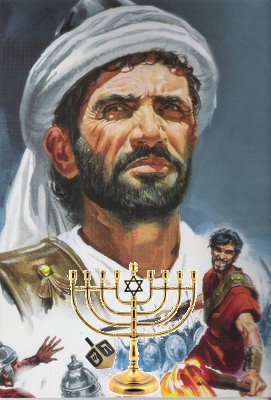
Originally called Chanukkat haMizbeach ('dedication of the altar'), Hanukkah is a minor eight day military holiday held by the Jews to commemorate the rededication of the Temple Altar after its defilement by the Greek pagan antichrist Antiochus Epiphanes. When the Jews cleaned out the temple idols, legend has it they found only one small cruse of oil with only enough oil for one day to light their holy lamps. They decided to light the Menorah (the Temple candelabra) even with the small amount of oil. To everyone’s amazement the Menorah miraculously burned for eight days until new oil was available. Unfortunately, this miracle almost certainly never happened (it does not appear in the first and second books of the Maccabees that record the event twice in some detail) but was invented by the Pharisees to bolster their hold on political power. The fact that the dedication lasted 8 days strongly suggests that Chanukkat haMizbeach was in fact a late Sukkot (which lasts 8 days), the inspiration coming from the permission granted Israel to have a late Passover or Pesach sheni (Second Passover) a month later when absolutely needed (Num.9).
The original Hanukkah was therefore a well-intentioned, once-only, though scripturally unwarranted late Sukkot combined with an altar dedication. Ordinarily a 12 day dedication is required by Torah (Num.7:11). As such, then, it was historically a 'once off' Sukkot sheni or 'Second Tabernacles' (2 Mac.1:18; 10:6), taking its inspiration from Solomon's 15 day-long dedication of the temple (2 Chr.7:9; 2 Mac.2:12) that later mutated into something it was never originally intended to be, containing a fake miracle to legitimise it as a separate festival all of its own. That mutation incorporated a 'feast of the fire' and magical nephtha-oil (2 Mac.1:19-22,31-32,36).
During Hanukkah Yah'shua (Jesus) spoke of His miracles (John 10:37-38). Yah'shua wanted the people of his day to see His miracles, point to His divine and messianic identity, and believe in Him as a result. But He did not observe the festival. Why?
- 1. Hanukkah was not a scriptural feast - Yahweh nowhere commanded Israel to observe it;
- 2. The historical essence of Hanukkah was liberty through war and self-effort, not the life-redeeming, intervening power of Yahweh;
- 3. The spirit of Hanukkah was anti-gentile - Yah'shua welcomed gentiles into the Kingdom;
- 4. Yah'shua refused to promote a Maccabean-type rebellion against Caesar; and
- 5. The spirit of the temple leaders was unreceptive to a man who came as Son of Elohim (God) to liberate people from sin.
Yah'shua did not therefore endorse the spirit of Hanukkah which commemorates the re-establishment of the Kingdom by violent means, contrary to the way of the Besorah (Gospel). However, there is no reason why we cannot use the history behind the original, unembellished Hanukkah as an an opportunity to teach believers about coming days of persecution and tribulation when the Anti-messiah (Antichrist) comes to power. Remember, the celebration of Hanukkah, with its special lights and ceremonies, is not commanded by Yahweh anywhere in Scripture and some of its elements are an outright fabrication. Moreover, there is strong evidence that these ceremonies borrowed from the pagan Saturnalia, like Christmas has. Therefore the festival is not observed by this ministry though we may on occasion use the 25th day of the 9th month to teach the facts behind the true historical events surrounding it.
|
Key: Art=Article | FAQ=Frequently Asked Question | Sc=Science | St=Sermonette | Occ=Occult | OB=Olive Branch | PCM=Patriarchal Christian Marriage | NCCM=New Covenant Christian Ministries | Sab=Sabbath | Sal=Salvation | 5Com=Five Commissions | AI=Apostolic Interviews | HO=Holy Order
C. Comments from Readers
[1] "This is an EXCELLENT article! It is the final confirmation for me, personally, as to why I, too, have been feeling very uneasy about celebrating this Jewish holiday .. one of the ONLY two annual feasts that IS purely Jewish - the other being Purim. The 7 commanded holy festivals in scripture are NOT Jewish feasts (contrary to popular belief), but YHWH's holy days! I have not celebrated Hanukkah for the last 3 years because I wasn't sure about the facts behind it. I've been researching it but haven't known exactly how to find ALL the info. Thank you for writing and posting this very important article, brother! Thank you for boldly and obediently speaking & teaching truth as the Ruach leads you" (JS, USA, 15 December 2018)
[2] "Our household doesn't keep Hanukkah! My understanding of John 10: Yah'shua went to Solomon's Porch to call the people to come out of the traditions of men (Isaiah 29:13; Mark 7:9-10). he tells those keeping Hanukkah, 'You are NOT of My Sheep. My sheep hear My voice and follow Me.'...Only a Remnant of Messianic Believers see this [truth]!" (VH, Canada, 20 December 2022)
[3] "You have posted some great articles on Hanukkah and Christmas...I learned something new today...Thank you for sharing this information on your website" (RMcC, USA, 21 December 2022)
[4] "Good article, thanks for sharing. Unfortunately many believers who came out of the religion of Christianity quickly exchanged its vile 'holy days' for Jewish ones. Many young lambs have been led to the slaughter by the wolves outside of the gate of safety in Messiah Yahushua. None of the man-made religious holy dates and/or traditions are applicable to those who are begotten-again and Ruach-filled in Messiah. Period" (HvZ, USA, 21 December 2022)
|
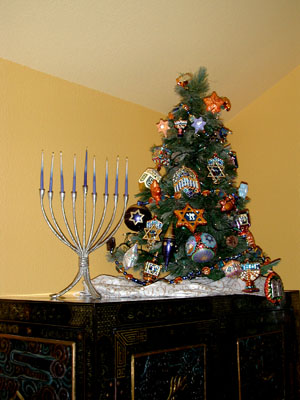 A Jewish Hanukkah Bush
The Parallel with the
Christmas Tree is unmistakable
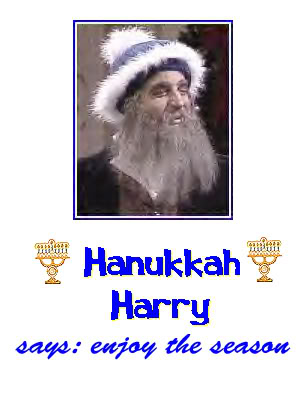 The Jewish Version of Santa Claus
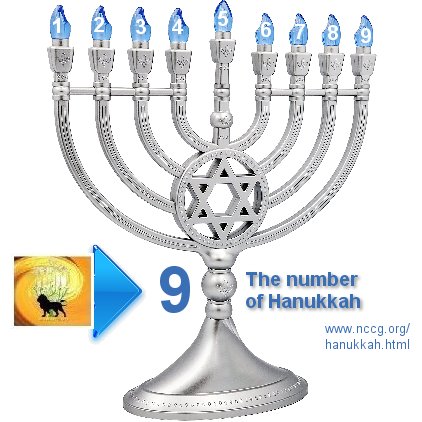
There are a variety numbers that hold secret significance within occult circles. Among the most common are 6, 9, & 13. 9 is the number we shall examine here as it is the number of Hanukkah with its 9-armed candlearbre. 9 holds powerful significance for many occult groups. Let's take a look at some of the arcane history behind the number 9.
Ancient Greek pagans held 9 sacred because to them nine symbolized the 9 Muses or sister goddesses, daughters of Zeus and Mnenosyne, who were believed to preside over mankind's activities on earth. Their names were: Calliope, Clio, Erato, Euterpe, Melpomene, Polyhymnia, Terpsichore, Thalia, Urania.
9 was also a significant number to the Etruscans. These ancient pagan people from north west Italy worshipped 9 gods. 9 was also a holy number in Rome. According to Texe Marrs, "the Romans honored the goddess Nundina by holding a purification ceremony for male infants on their nineth day of life. In addition, every ninth year the Romans held a feast in memory of the dead."
Satanists take delight in the number 9 for a couple of reasons. First, Satanists enjoy reversing, mirroring and inverting symbols, letters and numbers. When you turn the number '9' upside down you get '6' which, tripled, makes up the number of the Beast (666) as revealed in Revelation 13:18 in the Bible. Second, Satanists take perverse pleasure in commemorating the death of Christ and the death of Christ is associated with the number 9. Mark 15:34-37 reveals that Christ spoke his last words on the Cross of Calvary at the 9th hour and "beathed His last (died)" (NRSV).
According to the book Numbers: Their Occult Power and Mystic Virtues by W.W.Wescott, 9 holds great significance among many Masonic orders and secret societies. He said, "There is a Masonic order of Nine Elected Knights in which nine roses, nine lights, and nine knocks are used." In fact the number nine is the number of "the earth under evil influences."
In summary, the number 9 is an important numeric symbol to many occult groups and sole practitioners. Unlike the number 13 that almost all people know has some superstitious implications, the number 9 would be considered 'just another number' by the average person. (Adapted from Texe Marrs & David L.Brown)
|




This page was created on 28 September 2008
Last updated on 21 December 2022
Copyright © 1987-2022 NCAY - All Rights Reserved
|
|