1-4. Subordination, Unity and Distinctions
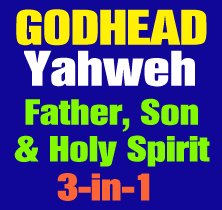
At the Baptism of Yah'shua the Messiah (Jesus Christ), He was in the Jordan, the Father's voice was heard from heaven and the Ruach haQodesh (Holy Spirit) descended on Him (Mark 1:9-11). Messiah prayed to the Father, and promised that the Father would send the Ruach haQodesh (Holy Spirit) (John 14:26). These passages prove that there are three distinct Persons in the Elohim/Godhead, thus disqualifying the claims of Jehovah's Witnesses (who reject the Ruach haQodesh's (Holy Spirit's) personality), the United Pentecostal Church (which claims that Elohim/God acts in three separate 'modes' but in never more than one at any time), and Unitarians.
At the same time that all Three are distinct, the presence of One means the presence of All. The Ruach Elohim (Spirit of God) in the heart means Messiah in the heart (Romans 8:9-11). There is a wonderful sequence in John 14:16,18,23 where the coming of the Ruach (Spirit) is the coming of Messiah Himself, and also is the coming of the Father to dwell with the believer. Therefore the Three Divine Persons of the Elohim/Godhead may be said to be ECHAD or ONE.
Beyond this the Bible does not go. Classical Trinitarians go much further, though, in claiming that the Father, Son and Ruach haQodesh (Holy Spirit) are CO-EQUAL. And whilst there are many scriptures that support this conclusion in one sense, there are many others which indicate that they are not co-equal in another (e.g. John 14:28; 5:19; 20:17; 4:23-24; Philippians 2:5-8; 1 Corinthians 11:3; 15:28; 8:6; 1 Peter 1:3; Mark 15:34; Revelation 1:1; 3:12; Matthew 20:23; etc.).
The full co-equality doctrine of classical Triniatrianism was nearly entirely absent from the teaching of the Messianic Community (Christian Church) in the first three centuries which taught a doctrine of SUBORDINATION. This doctrine about the Elohim/Godhead teaches that the Son is subordinate to the Father, and/or the Ruach haQodesh (Holy Spirit) is subordinate to both.
Controversy surrounded a final doctrine of the Ruach haQodesh (Holy Spirit) for many centuries with many interpretations being offered. The Pneumatomachi, while maintainig the divinity of the Son, denied the full Elohim/Godhead of the Ruach haQodesh (Holy Spirit) and their teaching was condemned by the Catholic Pope Damasus in AD 347 and was anathematised at the Council of Constantinople in 381 and its adherants persecuted out of existence by 383 when its victims became the victims of the Theodosian anti-heresy laws.
Though Messianic Evangelicals are by no means Pneumatomachi, we do believe that they were right up to a point. For we teach that whilst the members of the Elohim/Godhead are not co-equal in terms of authority and power of themselves, that they are co-equal by jurisdictional declaration of the Father. This means that both the classical Trinitarian and Pneumatomachi position are considered true by us. It is the only way to reconcile the two seemingly opposed sets of scriptures, the one teaching trinitarian co-equality and the other pneumatomachian subordinationalism.
This has necessarily been a long and rather technical look at the Ruach haQodesh (Holy Spirit) because it is an area of disagreement between Messianic Evangelical Proto-Trinitarianism and the 'classical' Trinitarianism evolved by the Catholic Councils at Nicea (325) and Constantinople (381).
Messianic Evangelicals claim no ultimate solution to the Elohim/Godhead Mystery. There is no, final NCAY dogma. We do, however, insist that all the Scriptures be taken into consideration.


This page was created on 18 July 1999
Last updated on 16 February 2017
Copyright © 1987-2017 NCAY - All Rights Reserved