
 346
Shavu'ot/Weeks/Pentecost 2001
346
Shavu'ot/Weeks/Pentecost 2001
Sabbath Day Sermon, 26 May 2001
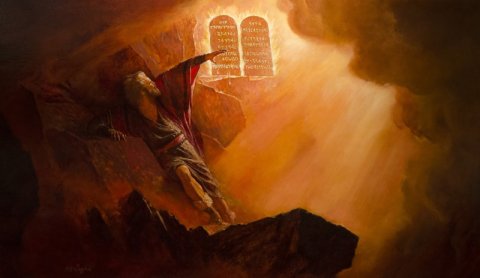
In two days' time, the required number of days will have passed since we celebrated the Feast of Firstfruits or Yom haBikkurim, days which Israelites have carefully checked off on their calendars for thousands of years, and marks the end of the first wheat-growing season in the Holy Land. That is why it is sometimes called 'Pentecost', from the Latin pente meaning 'fifty'. It is also called the 'Feast of Weeks', as seven weeks were also to be counted, plus one day, thus making a total of 7 sabbaths + 50 days. However, it is not the wheat-growing season that is so much of interest to us as the fact that it was on this day that Israel celebrated the receiving of the Torah or Law on Mount Sinai through Moses. That is why symbolically we always represent Shavu'ot with the Ten Commandments.
The Law or Torah is qadosh (holy, set-apart). All laws and regulations that man needs to be happy derive from these Ten Commandments. But man, by nature, is not a law-loving being. He is rebellious and lawless because of the fallen fleshy nature he has acquired since Adam and Eve fell. As a result, man doesn't like to be governed. He wants to be his own government and his own law. There is even a political doctrine called anarchism which enshrines this concept - anarchists want to abolish government altogether.
Because Yahweh's Torah (Law) is so important we are commanded to commemorate it at this time every year. Part of our covenant as believers is to willingly subject ourselves to Torah and specifically relates to the men. Thus Shavu'ot was one of the three annual feasts when all young men were required to appear before Yahweh. It is a Pilgrim Festival. This was not required of the women who come under the authority and law of their husbands and fathers. The men and women were accordingly given their own symbolic practices to indicate that there were under divine government, and it a law that is still in force to day: the women are commanded to wear head coverings to show submission to their husbands (if married) or to their fathers (if unmarried), and the men are commanded to wear tzitzit (four tassels) on their robes to show their submission to Yahweh's mitzvot (commandments) The wearing of head-coverings and tzitzit is the external evidence that we are under discipleship - it is one of the signs of obedience to Elohim (God).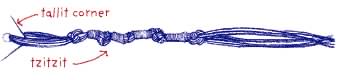 Although we as a people have always practised the wearing of head coverings for our women, we have been negligent of tzitzit. As soon as we have them made, male converts will wear these as a reminder that they are under the mitzvot (commandments) of the Most High.
The fact that three festivals per years required the men to rededicate themselves to the mitzvot (commandments) shows how vitally important the commandments are to the spiritual life (Ex.23:17; 34:23; Dt.16:16). Historically, the main activity on the Feast of Weeks ('Pentecost') was the presentation of a wave offering to Yahweh consisting of two loaves of bread with leaven (Lev.23:15-21). The bread was to be brought with seven male lambs, a young bull and two rams as a burnt offering (Lev.23:18). The sin offering was a male goat (Lev.23:19). Since all of these types have now been fulfilled in Messiah, they are no longer practised.
The Covenants which Yahweh established with His talmidim (disciples) are never to be taken casually. Elohim (God) takes them very seriously indeed, and they are compared to marriage covenants. Once the covenant is made, it is eternal. Like a husband protective of his wife, Yahweh is a jealous Elohim (God) - not in the human, negative sense of jealousy, but in the positive sense, something that really only godly husbands can fully appreciate. Whilst He desires spiritual intimacy with us just as a husband does with his wife, He is also an Elohim (God) committed in marriage to us by His rights as an allegorical Husband. When we violate Him, through types of spiritual adultery, we rightly face His jealous wrath, just as a husband does if his wife commits adultery. That is how deep and sacred the covenant bond we have with Yahweh is.
Marriage is so sacred, in fact, that the Bible teaches that there are no grounds for divorce. Once two believers marry, they are always married, no matter how terrible the other partner may be. A woman may separate and remain single, but not divorce her husband. The only grounds for divorce between believers - those under the Gospel Covenant - that Yah'shua (Jesus) gives are if a betrothed woman sleeps with another man, in which case the betrothed husband is released from his covenant if he so chooses. Paul describes the only other ground for divorce, namely, if one or other of the parties is an unbeliever, and the unbeliever chooses to leave the marriage.
Adultery is a heinous crime in Yahweh's eyes, second only to murder. And since our relationship to Him is akin to a marital one, with all the wonderful blessings of spiritual closeness that that brings, adultery is severely punished. Let us not forget that on the day the Torah (Law) was given to Israel that 3,000 souls died due to disobedience.
Becoming a Christian/Messianic and entering the baptismal covenants is every bit as serious - in fact, more so - than getting married. It is never something to be entered into lightly. I spent three weeks, you will remember, discussing how young people should carefully choose their marriage partners, and not to bind themselves until they were willing to be faithful for ever. See, Whom Should I Marry?
It is no different in entering into a covenant with Elohim (God). Just as a wife pledges to be submissive and obedient to her husband in Messiah, so we as believers pledge submission and obedience to the mitzvot (commandments) and to the will of our Heavenly Father. In return, the man is to love, protect and cherish his wife, just as the Father loves, protects and cherishes us, His sons and daughters.
In the festival of Shavu'ot, only the best fruits were chosen. The men would select the best grapes and dates to give to Yahweh, just as we are to give the best of everything to Yahweh, loving and serving Him first above everything and everyone else. The wave offering expressed the Hebrews' dependence on Yahweh for their harvest and their daily bread, so this was a thanksgiving offering. The link between Passover (Pesach) and the Feast of Weeks or 'Pentecost' (Shavuot) is the omer, which refers to an amount measured. On the second night of Pesach (Passover) the barley is harvested and the first sheaf is waved before the altar in the Temple. On Pentecost two loaves are waved as an offering before the same altar.
Shavu'ot is therefore a wedding feast - an allegorical wedding between Yahweh and Israel. Some three thousand years later another wedding took place - or rather, the completion of the first wedding. Just as our admission into the Kingdom consists of three steps - baptism, Chrism and the Master's Supper, so marriage consists of the three steps of Dedication, Betrothal and Full Marriage. This comparison is very significant, as you will see now, I hope, in this chart:
| 1 |
Human Marriage |
Dedication (Engagement) |
Betrothal (Spiritual Marriage) |
Full Marriage |
| 2 |
Marriage to YHWH |
Torah at Mt. Sinai |
Baptism of Ruach/Spirit at Pentecost |
Marriage Feast of the Lamb in Heaven |
| 3 |
Covenant Ordinances |
Water Baptism by Immersion |
Chrism (Confirmation, Bar/Bat Mitzvah) |
Master's Supper (Heavenly Meal) |
| 4 |
Messiah's Passion |
Death |
Resurrection |
Ascension into Heaven |
| 5 |
Life |
Birth |
Growth |
Maturity |
Let's take a look at it more closely. The process that leads to marriage starts with the ordinance of Dedication, the nearest equivalent of which in our secular world is 'Engagement'. It is a real commitment to find get married to someone but can be broken off if things don't finally work out. Since marriage was created by Yahweh, and since Yahweh knows best who our marriage companions ought to be, marriage also belongs to Yahweh. So true marriage - the marriage which is eternal - must be marriage ordained by Yahweh Himself. He is therefore the matchmaker. And the ideal biblical example is that of Isaac and Rebekah.
It is not possible, however, to know Yahweh's will until we have learned to be obedient to Him. The very act of obedience to His mitzvot (commandments) teaches us about the nature of our Heavenly Father. We discover, though obedience, what His character is like, and through knowing His character, we learn how to walk in harmony with Him and His perfect ways. The Law of Torah was given in order that we might know Him and what it is to walk along the spiritual path of life. That is why I have placed the giving of the Law at Mount Sinai in the same column as Dedication.
In the Christian/Messianic life we indicate that we intend to walk in the path of holiness through obedience to Elohim (God) by being baptised, and as everyone knows, being immersed in water indicates complete death to self and rebirth in our Father's life and power. It is, like Dedication, more of an intention than a reality. The new Christian/Messianic soon discovers how hard it is to put the fleshy nature to death and to walk in the Ruach (Spirit). Our stubborn, rebellious, independent-minded fallen Adamic nature does not want to die, and so it resists. It is often at this stage that we begin to realise that we have far more problems than we want to admit. We think we are better than we are when we are not. And so we get quite a jolt to our pride.
One of the reasons why it is so important that young people 'in love' do not get married the next day is because this kind of passion-love, which the Bible calls eros, blinds us not only to Elohim's (God's) will but to the true nature of the one we are infatuated with. We need time to settle and see things clearly.
New converts soon discover that the spiritual life isn't at all what they at first imagined it to be. Part of the reason is that they look upon Yahweh and His mitzvot (commandments) through carnal eyes, and like the magician who wanted to buy the Ruach haQodesh (Holy Spirit) off the apostles, think that it is possible to live the Besorah (Gospel) through the flesh. What happens is that they start living the Besorah (Gospel) artificially, 'putting on an act', if you like, trying to force themselves to be a particular way even though it isn't coming naturally to them. Such end up living an illusion if they are not very careful. And that is why we have Shavu'ot (Weeks, 'Pentecost'), the second stage in the process of being reborn in Yah'shua (Jesus).
The first stage of our discipleship, as represented by Baptism in the Besorah (Gospel) ordinances, and by Dedication in the marriage process, and by the giving of the Ten Commandments and the rest of the Torah (Law, Teaching) at Mount Sinai, is an outer process. We see, we believe, we want to be obedient because we want eternal life and we want everyone else to have it as well. But we're still on the 'outside', as it were - it has not naturally become a part of us yet, even though we may think it has.
I've never met someone who was in love who didn't think that marriage was going to be a breeze. They are starry-eyed, full of idealism and hope, and have no idea of the struggles and sacrifices that are required. New converts to Messiah come with similar naïve ideas, thinking that they are so wonderfully Messiah-centred and that they are going to win souls just by opening their mouths and witnessing. Like those engaged to be married, the new convert soon has a big shock. The lessons of life soon humble him into realising that he is a lot smaller than he realised and that the Way is not easy.
That is why Yahweh, in His great ahavah (love) and chesed (mercy), gave the Israelites Shavu'ot, to prepare them for the time when He would send the Ruach haQodesh (Holy Spirit) in great power centuries later on the Day of 'Pentecost', which are, of course, one and the same. The only difference between the first 'Pentecost' at Mount Sinai and the 'Pentecost' in the upper room in Jerusalem when the eleven apostles gathered together after Yah'shua's (Jesus') death, resurrection, and ascension, was that the Torah (Law) became written on the hearts from the inside-out by the Ruach haQodesh (Holy Spirit). That is very, very important to understand.
There are two ways of living the Besorah (Gospel) of Yah'shua the Messiah (Jesus Christ): by doing it in our own strength, and by doing it through the power of the Ruach (Spirit). The first is impossible no matter how much willpower you have. In the end you will fail. There are many churches who try to do it in this way and they turn their members into guilt-ridden wrecks who have no spiritual power in their lives.
New Covenant Shavu'ot and Old Covenant Shavu'ot are therefore very different. In some respects the Old Covenant way is 'unnatural' - a bit like someone who knows it is Elohim's (God's) will that he is to marry a woman, who obeys, but feels no love. In the end the marriage becomes a heavy burden instead of a pure simcha (joy). New Covenant Shavu'ot or 'Pentecost' is like someone who knows who they are to marry, loves them, and who finds marriage pure simcha (joy). Finally, it must be said that there is what one might call a 'False Shavu'ot' in which a man falls in love with a woman he isn't supposed to marry, discovers when it is too late that they are incompatible, and they have a terrible struggle holding the marriage together, until in all likelihood it falls apart.
You can't live the Christian/Messianic life without the Baptism of the Ruach haQodesh (Holy Spirit). If you try, you will not only fail but your Christian/Messianic behaviour will be artificial and unnatural. Most people who try to live the Besorah (Gospel) in this way fail, often stop being Christians/Messianics, and turn against Christianity. The tragedy is that they never actually knew what Christianity was because they only saw and experienced it from the inside without the Gift of the Ruach (Spirit). The difference is enormous.
So why do the experiences of so many who try to be Christians/Messianics lead them away from Messiah? The reasons can be several.
They may not have been taught the Besorah (Gospel) properly. A person who isn't taught how to drive a car properly and who then goes and crashes a car and refuses to drive a car again, blaming the car, is, you would agree, foolish, when the problem lay with his lack of education.
But the most likely reason, and one I have seen so often, is that people don't want to die to self. You will notice in the fourth row I have put Messiah's Passion, that is, the process which led to His atonement for us. It took place in three stages: His death, resurrection, and ascension into Heaven. In order to become a Christian/Messianic and grow to perfection in Messiaht and so inherit the highest reward in heaven, we must go through a parallel process represented by the ordinances of Baptism, Chrism (Confirmation, Bar/Bat-Mitzvah) and the Master's (Lord's) Supper.
In other words, we must first die to self symbolised by the ordinance of baptism, the water representing the grave. The Law or Torah shows us what our sins are and pronounces us dead to eternal life as we discover we aren't living the Torah (Law, Teachings) as we should. But it is no use remaining dead, is it? So what does Yahweh do? In His great chesed (mercy) and loving kindness, He sends us the power to live the Torah (Law) joyfully, lovingly, from the inside-outwards. We can tell when this has happened to us because our whole nature is changed. From being selfish, self-serving, and mean, we forget self, think only of blessing those around us, and start showering deeds of kindness on our family, neighbours, and those we can influence in our daily life. When this begins to happen naturally and spontaneously, without having to force yourself to do them, you know the Ruach haQodesh (Holy Spirit) has come.
But that is not the end. It's the second of three stages only. In a way, it's the most important part of your spiritual journey because you are at least moving. The first stage is a bit like buying a car without petrol/gas and parking it on the road that leads to eternal life. It is a vitally important stage but if you stop there you have actually acquired nothing. Were you to just sit there without the spiritual life you would have no guarantee that you are going to make it to heaven. You must first die to selfish ambition and let Elohim (God) take over your life completely and not selectively. What's the point of buying a car without wheels? What use would that be to you? Or one without an engine? It might look nice on the outside but it would be worse than useless, wouldn't it?
The Day of 'Pentecost' (Shavu'ot) is the day that the talmidim (disciples) were baptised in fire. They were already believers - remember that - but they lacked the inner power to make their Christian/Messianic life a victorious one. Until that happened, they really hadn't changed very much as people - they were their old selves with a layer of Christianity/Messianism on top. They didn't really understand what the Besorah (Gospel) was all about until the Ruach (Spirit) came and inscribed it in their hearts.
The parallels between what happened on Mt.Sinai and what happened in that upper room after Messiah's resurrection are highly significant. In the second chart you will see that they are:
| The Mitzvot (Commandments) Given |
The Ruach haQodesh (Holy Spirit) Given |
| 7 sabbaths + 50 days from the crossing of the Red Sea (Yam Suf) |
7 sabbaths + 50 days from the resurrection of Messiah |
| Torah (Law) of Yahweh written in stone |
Torah Law of Yahweh written on our hearts (Jer.31:33) |
| 3,000 slain |
3,000 receive salvation |
| The letter of the Torah (Law) |
The Spirit of the Torah (Law) |
| Symbol |
Reality |
| Grain of wheat |
Messiah (Jn.12:23-24) |
| Two loaves with leaven (Lev.23:15-17) (cp. Ephraim and Judah) |
Judahite and Gentile believers in Messiah |
| As the wheat is beaten and refined as fine flour (Lev.23:17) |
Messiah beaten, sifted, and crushed (Is.28:28; 52:14; 53:1-6) |
| Harvest |
Salvation (harvest of souls) |
| Rain |
Outpouring of the Ruach haQodesh/Holy Spirit (Ac.1:4; 2:1-4) |
That the first Christians/Messianics were baptised (immersed) on the Day of 'Pentecost' (Shavu'ot) was absolutely no accident because the feast of Shavu'ot was actually a prophetic sign of what was to happen in the days of Messiah. Again we see how all the festivals point to Messiah the Master.
The third and final part of our journey, represented by full marriage and the ordinance of the Master's Supper, is yet to come. That is represented by another festival (Sukkot/Tabernacles) later during the year.
In the meantime, what is important is this: if we have accepted Messiah as our master and Deliverer (Saviour), have we taken the next step to completely die to self-will? If not, we cannot be baptised by fire and cannot live the Besorah (Gospel) from the inside-out joyfully. Until we do that, our Christianity/Messianism will remain a personal one unconnected to other people and to reality around us. Without Shavu'ot (Weeks, 'Pentecost'), we are living a solo-Christian/Messianic Besorah (Gospel), like a car without an engine, and are in truth on the way to perishing.
And so, finally, that brings us to the fifth and last row - life itself, and we see the same process in action. When we are born, we in a way die - leaving one world of the womb into the big wide world outside. The womb is comfortable, warm, and safe, but it is not the fullness of life. And the birth process isn't particularly enjoyable, either for the baby or the child. And sometimes it can be risky.
But even then the dangers are not over. The new-born child faces many difficulties. He must grow or perish. And so it is with us in the Christian/Messianic life. You cannot just believe in Messiah and sit on the ground hoping everything will happen automatically. You must respond. In the womb a baby is nourished automatically viâ the umbilical cord of its mother, but outside the baby must be willing to eat.
In our household we are surrounded by small children. Every day we hear them protesting, don't we? They want to do things their way, and when they can't, they kick up a big fuss. The new-born Christian/Messianic is no different. He may think he's the King of the Castle but he isn't - he's still an undisciplined child in need of correction, guidance and ahavah (love). He can't make it on his own.
The new-born Christian/Messianic is given the Messianic Community or Church family for his nourishment and ahavah (love), but without the baptism of the Ruach (Spirit) even this isn't much use. Similarly, a child who has no will to live cannot make much progress in life even if ahavah (love) is lavished on him. May Shavu'ot/Weeks/'Pentecost', which you will be celebrating while I am abroad, be a time of deep personal reflection for everyone.
For those who have not yet died to self, however 'good' that self may appear to them, finally put it to rest and invite the Master Yah'shua (Jesus) to give them their own personal Day of 'Pentecost'. This is my prayer in Yah'shua's (Jesus') Name. Amen.

This page was created on 1 July 2001
Last updated on 28 July 2016
Copyright © 1987-2016 NCAY - All Rights Reserved