

 141
IS GOD A SPIRIT?
141
IS GOD A SPIRIT?
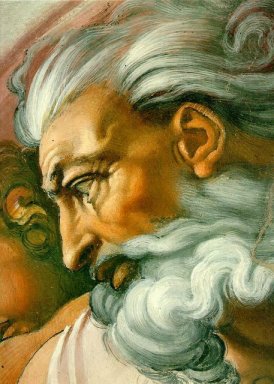
Critiquing the 'Orthodox' Doctrine that Elohim is Formless
Is God (Elohim) a spirit? This might, at first sight, seem rather an unusual question as most people who believe in God automatically assume that Elohim (God) is a spirit. But what do we mean by "spirit"? The Concise Oxford English Dictionary defines a spirit as "the intelligent or immaterial part of man", a "rational or intelligent being not connected with the material body". When we speak, therefore, of the spirit of man, we speak of man's non-material aspect. And when people speak of Elohim (God) it is assumed that since He is "a spirit" that He is non-material.
A spirit (the old English being "a ghost") is the part of a living man, or the part of a disembodied dead man, which cannot be touched with physical hands. Yah'shua (Jesus), after His resurrection, appeared before the frightened apostles who supposed that He was "a spirit". To dispell their doubts and fears, He invited them to touch Him, saying: "Why are you troubled, and why do doubts arise in your minds? Look at my hands and feet. It is Myself! Touch Me and see; a ghost (spirit) does not have flesh and bones, as you see I have" (Luke 24:36-39, NIV).
Most Christians acknowledge that the resurrected Messiah (Christ), the second member of the Elohimhead (Godhead), is not "a spirit" but a resurrected Being -- that is, a Being possessing both spirit and flesh. They acknowledge that He can be touched, that He is physical. Like Thomas, they acknowledge His deity, and can say of Yah'shua (Jesus: "My Lord (Master) and my God (Elohim)!" (John 20:28). They are able, in harmony with Paul the apostle, to say that "Messiah Yah'shua (Christ Jesus), who being in very nature (in the form of) Elohim (God), did not consider equality with Elohim (God) something to be grasped" (Philippians 2:5-6, NIV). With Paul, they can declare: "For in Messiah all the fulness of the Deity lives in bodily form" (Colossians 2:9, NIV). Yah'shua (Jesus) Himself says: "I and My Father are one" (John 10:30, AV), and "I tell you the emet (truth), the Son can do nothing by Himself; He can only do what He sees His Father doing, because whatever the Father does the Son does also. For the Father loves the Son and shows Him all He does" (John 5:19-20, NIV).
All true Christians are therefore able to say that:
- Yah'shua (Jesus) is Elohim (God);
- Yah'shua (Jesus) possesses the fullness of Deity (Godhood);
- Yah'shua (Jesus) has a resurrected, physical body;
- Yah'shua (Jesus) and the Father are one;
- Yah'shua (Jesus) only ever did what He saw His Father doing.
These things being true, all Christians ought also to be able to say:
- Elohim (God) has a resurrected body of "flesh and bones" like Messiah (Christ) (Luke 24:36-39),
for Yah'shua (Jesus) is in every way like His Father, copying everything He did and does.
"But it says in John 4:24 that 'Elohim (God) is a spirit: and they that worship him must worship him in spirit and truth!'", is the immediate response.
But is that what the text actually says?
Elohim (God) is Spiritual in Nature (John 4:24)
Almost without exception, every translation of John 4:24 leaves the clear impression that Elohim (God) is a spirit -- an immaterial, untouchable Being. But what is the warranty for such a translation? And is not this translation inspired by preconceived doctrine rather than by a proper rendering of the Greek?
The original Greek says pneuma ho theos which literally translated is: "Elohim (God) is spirit", or better still, "Elohim (God) is spiritual in nature", the noun being anarthrous (without the definite article "a").
We know that this is the correct translation because other New Testament passages use the same grammatical construction. 1 John 1:5 is correctly translated as, "Elohim (God) is light" in virtually every Bible version. Similarly, 1 John 4:8 is rendered, "Elohim (God) is ahavah (love)."
But if the translators had followed the faulty translation of John 4:2 which they incorrectly rendered as "Elohim (God) is a spirit", then they ought to have rendered 1 John 1:5 and 1 John 4:8 as: "Elohim (God) is a light", and "Elohim (God) is a [species of] ahavah (love)", respectively, which does violence to Greek grammar and is plainly nonsense.
The Context of John 4:24
John 4:24 must further be seen in context. Though used almost universally by Christians as a proof text that Elohim (God) is a formless, non-material Spirit Being, these words of Yah'shua (Jesus) were not given to define Elohim's (God's) form or substance but to reveal His spiritual nature. These words were given in reply to a question by a Samartian woman who supposed that the true Elohim (God) could only be worshipped in a Temple of stone and wood. To correct her essentially materialist view of worship, Yah'shua (Jesus) declared that Elohim (God) the Father, being spiritual by nature, can only be worshipped "in spirit and in emet (truth)" (John 4:23). Thus true worship does not require physical devices like temples, church or synagogue buildings, wooden crosses, or any of the apparatus that was used by the Jews in their temple -- true worship is to make contact with Elohim (God) through the spirit in man, for Elohim (God) is Himself spiritual by nature.
There is a real diference between "a spirit" and "spiritual". A man may be spiritual whether he has a physical body or not, because the word defines his nature, not his form or substance. Thus Abraham, who is a spirit in Paradise (the spirit world), is spiritual; but when he was on earth in right relationship with Elohim (God) he was also spiritual. Thus to be spiritual is not to indicate whether the person possesses a physical body or not.
Elohim (God) and Messiah (Christ) are Alike
In several instances in the Tanakh (Old Testament) Elohim (God) the Father (Yahweh) is shown to have a physical form like the resurrected Messiah. In one of the most spectacular encounters in the Bible, the patriarch Jacob wrestles with the Elohim (God) of Abraham. Though most Bible translations say that Jacob wrestled with a "man" or an "angel" (messenger), Jacob insists that he saw "Elohim (God) face to face" (Genesis 32:30). Various attempts have been made by theologians to explain this away or "demythologise" it but the text as it stands is plain: Jacob wrestled with Elohim (God) face to face, a physical being, who dislocated his thigh, and who renamed him Israel. Ghosts, or spirits, don't wrestle and dislocate thighs!
Moses had a similar encounter when he and seventy elders of Israel met with Elohim (God) on the top of Mount Sinai and ate a meal with Him. Spirits do not eat food! Indeed, as further proof of His physical nature, the resurrected Messiah asked His apostles for some food, whereupon he ate some "broiled fish, and of a honeycomb" (Luke 24:42, AV). Of Moses, the Bible frequently states, "Yahweh would speak to Moses face to face, as a man speaks with his friend" (Exodus 33:11, NIV).
That Yahweh-Elohim (God) the Father has form and the same kind of substance as the resurrected body of Messiah which can be touched, wrestled with, and can eat is revolutionary thinking for most Christians, but the Bible is unequivocal about it. This is not, however, to say that Elohim (God) has an anthropomorphic or human form -- it is, however, to say that mankind is theomorphic, or created literally -- spirit and flesh -- in the image of Elohim (God).
Man Created in Elohim's (God's) Image
The first chapter of the Bible says: "Then Elohim (God) said, "Let us make man in our image, in our likeness..." (Genesis 1:26, NIV). The word for "God" in the Hebrew is Elohim and is what is called a "uniplural noun". Literally translated, the word Elohim means "gods" and is frequently used in the Old Testament to describe human judges too. Here, though, Elohim is a title for Elohim (God) that not only depicts the plurality of His majesty but also the plurality of the Elohimhead (Godhead).
It is plain from the text that more than one divine Person is involved in the creation, as is evidenced by the use of the plural forms "us" and "our". The New Testament teaches that Yah'shua (Jesus) pre-existed the creation and was Himself Elohim (God), or part of the Elohimhead (Godhead) (John 1:1). It also teaches that Yah'shua the Messiah (Jesus Christ) created the world at the command of His Heavenly Father (John 1:10). It is reasonable to suppose, therefore, that the Elohim of Genesis 1:26 refers to both Elohim (God) the Father and the pre-existent Yah'shua the Messiah (Jesus Christ) since elsewhere we are told that Elohim (God) created the universe through His Son.
Mankind is therefore made in the express image of Elohim (God) the Father and Elohim (God) the Son. This same wording is used to describe the relationship between Adam and his son Seth: "When Adam had lived 130 years, he had a son in his own likeness, in his own image; and he named him Seth" (Genesis 5:3, NIV). Thus the testimony of Paul, in which he says that "we are [Elohim's/God's] offspring" (Acts 7:28-29), suggests that the relationship between Elohim (God), Messiah, and man is closer than most ordinary Christians might care to admit. We, as human beings, are physically and spiritually created in the image of Elohim (God), just as Seth was the literal offspring of his father Adam.
A Revolutionary Doctrine, a Revolutionary Book
The testimony of the Bible that Elohim (God) is anthropomorphic with whom men have eaten and wrestled is revolutionary for many Christians. But then the Bible is a revolutionary book. Yet it is a little strange that the physical resurrection of one member of the Godhead (Godhead), the Master Yah'shua the Messiah (Jesus Christ), is accepted without question but not the theomorphic nature of man.
Some of the confusion has been caused by Paul's usage of the word "spiritual" to describe the resurrected body:
"So it will be with the resurrection of the dead. The body that is sown is perishable, it is raised imperishable; it is sown in dishonour, it is raised in glory; it is sown in weakness, it is raised in power; IT IS SOWN A NATURAL BODY, IT IS RAISED A SPIRITUAL BODY. If there is a natural body, there is also a spiritual body" (1 Corinthians 15:42-44).
Many, reading this passage, have wrongly supposed that the resurrected body is just "a spirit" (Greek pneuma), that is, a body made of spirit substance, the "other half" of the soul made up of body and spirit; but Paul uses the word "spiritual" (Greek, pneumatikos), that is, a body which becomes spiritual BY NATURE.
What this passage means is that human flesh, which is presently the seat of man's fallen nature, becomes transformed by the resurrection power of Messiah to become "spiritual in nature" like that of Messiah. Man's evil inclinations will therefore be expunged. His flesh will become "spiritual".
Matter is Not Evil
I suspect the reason why the dogma of God being "a spirit" has evolved in Christendom is because of a non-Biblical doctrine that arose in the first centuries of the Christian Church which taught that matter was inherantly evil. This doctrine was espoused by the Gnostics and never became entirely expunged from "orthodox" Christianity. It was the impulse behind the establishment of the Christian asceticism of monastic orders. This doctrine in turn led to the doctrine of the supremacy of celibacy in the Christian life.
It is impossible, in our view, for Elohim (God) to have been the creator of something evil. Elohim (God) is the creator of both spirit and matter. Though we would acknowledge that matter is fallen because of the transgression in Eden, we would also maintain that, by the sanctifying power of Messiah, that it can be -- and will be -- transformed into something spiritual and qodesh (holy, set-apart).
False Doctrine Leads to Wrong Lifestyles
Yah'shua the Messiah (Jesus Christ) testified: "And this is life eternal, that they might know thee the only true Elohim (God), and Yah'shua the Messiah (Jesus Christ), whom thou hast sent" (John 17:3, AV).
To have a proper appreciation of Elohim (God) the Father (Yahweh) and His Son means that we must know what kind of an Elohim (God) He is. His spiritual nature is generally understood by Christians, for He is declared to be an Elohim (God) of ahavah (love), which Paul expounds in his beautiful discourse in 1 Corinthians 13. But we are also physical beings rooted in a physical world and if we are to live in harmony with Elohim (God) in this world, and if our presence here is taken to be Elohim's (God's) will for our spiritual development, then we must have a right attitude to it. To do this we need to know what Elohim's (God's) relationship to physical matter is also, for to understand that He too is, in some way, "physical", albeit "spiritual-physical", gives us a proper perspective of mortal existence.
We are not, therefore, to regard the physical flesh (as opposed to the fleshy nature) as evil as certain extreme sects of Christendom do, nor are we to try to transcend it, as certain oriental religions are wont to try. Neither are we to seek out celibacy as being a higher state of existence in this world than marriage, but rather obey the commandment given at the beginning to "multiply and replenish the earth" (Genesis 1:28). We are to accept Yahweh's declaration that the physical creation is "good" whilst realising that sin has entered into the world and corrupted all flesh. We are to seek for the atoning power of Messiah's blood for the forgiveness of sins and the power of sanctification for body and spirit, until our physical bodies are restored into the spiritual image of Elohim (God) once more, in the form Adam's body existed in before the Fall.
Face to Face
Knowing that Elohim (God) has the same form and susbtance as the resurrected body of Yah'shua the Messiah (Jesus Christ) means also that we, like Moses, will be able to see Him face to face and commune with Him as a man talks with his friend. Through prayer we learn to approach the face of Elohim (God) degree by degree until our faith is made perfect, the veil is rent, and we can see Elohim (God) as He really is.
Clearly we need to know what the Bible really teaches if we are to come to a correct understanding of Elohim (God). For this reason Christians must do more than accept one Bible translation and accept it as translated 100% correctly. No translation is perfect because no human translator is perfect, even though he may be divinely inspired when he translates. Clearly some translations are better than others; nevertheless, the believer must be prepared to search deeper and obtain the original sense of the Bible writers. Such will mean an investment of time and effort. It means, moreover, living close to Elohim (God) so that he can get to know Him, "line upon line, precept upon precept" (Isaiah 28:10,13, AV).
A Messianic Community of Revelation Established
The New Covenant Assembly of Yahweh is a Messianic Community of contemporary believers attempting to live close to the face of Elohim (God) through emunah (faith) in the Master Yah'shua the Messiah (Jesus Christ) and obedience to His Davar (Word). Many obscure Biblical passages have been clarified through the medium of prophetic revelation. Elohim (God) has established a B'rit Chadashah (New Covenant), calling earnest believers in the Master Yah'shua (Jesus) and seekers after emet (truth) to "draw near with a pure heart" (Hebrews 10:22, AV) and live the Besorah (Gospel) in its purity and wholeness.
If you are one of those believers or seekers after emet (truth), please get in contact with us.
POSTSCRIPT - BEWARE OF MODERN HERESY
There are those, like the Jehovah's Witnesses and some Messianics, who teach that after resurrecting 'physically', Yah'shua (Jesus) reverted to being a 'spirit'. In other words, the materialisation was only temporary in order to bolster the talmidim (disciples') 'weak faith'. This is tantamount to 'divine deception', is contrary to the nature of Elohim (God) and a denial of the eternal physical resurrection. It is, in short, a dangerous doctrinal heresy that undercuts the believer's hope in the future resurrection. Yah'shua's (Jesus') body is viewed as more than a temporary 'shell' in line with New Age Christian thinking. This doctrine is used by some Messianics to deny the plurality of the Elohimhead (Godhead) by insisting that the Father and the Son are one person, the Father allegedly incarnating in a human body to become the 'Son', and becoming the 'Father' again upon vaccating it after dissolving the physically resurrected body. Needless to say such a skewed doctrine implies a divine form of Multiple Personality Disorder (MPD) where the 'Father' and the 'Son' converse with one another as though they were two separate beings when in fact (according to this false doctrine) they are one person.
The Father and the Son are distint Persons, have always been so and will always be. The fact that the Father and the Son are both called 'Yahweh', and that the Son is called "Father" in Isaiah 9:6 does not prove that they are one Person. Rather, Yah'shua (Jesus) has been given the Father's office until such a time as He returns it:
"But now Messiah is risen from the dead, and has become the bikkurim (firstfruits) of those who have fallen asleep (died). For since by man came death, by Man also came the resurrection of the dead. For as in Adam all die, even so in Messiah all shall be made alive. But each one in his own order: Messiah the bikkurim (firstfruits), afterward those who are Messiah's at His coming. Then comes the end, when He (Yah'shua/Jesus) delivers the kingdom to Elohim (God) the Father, when He puts an end to all rule and all authority and power. For He must reign till He has put all enemies under His feet. The last enemy that will be destroyed is death. For 'He has put all things under His feet.' But when He says 'all things are put under Him,' it is evident that He who put all things under Him is excepted. Now when all things are made subject to Him, then the Son Himself will also be subject to Him who put all things under Him, that Elohim (God) may be all in all" (1 Cor.15:20-28, NKJV).
CAN A SPIRIT HAVE A SPIRIT?
Those who deny the Father, Son and Holy Spirit are separate persons in the Elohimhead (Godhead) create insurmountable problems for themselves. For instance, if Elohim (God) exists as a form of modalistic monarchism, switching hats in different rôles ('Father rôle', 'Son rôle' and 'Holy Spirit rôle'), and if Elohim (God) is either 'spirit' or 'a spirit', then how can Elohim (God), who is 'spirit' or a 'spirit' then, as Scripture testifies, have a spirit! Each one of the 26 instances of "the Spirit of Elohim (God)" (e.g. Gen.1:2; 1 Cor.3:16) then makes no sense because how can a 'spirit' have a 'spirit'? That's tautology of the worst kind.

This page was created on 17 April 1998
Last updated on 22 November 2013
Copyright © 1987-2013 NCCG - All Rights Reserved