

 30
THE STRICTNESS OF THE WAY
30
THE STRICTNESS OF THE WAY
Confronting Laxity in the Modern Churches
Jesus said: "I am the Derech (Way) and the Emet (Truth) and the Chayim (Life). No one comes to the Father except through Me" (John 14:6, NIV).
Before the term 'Christian' or 'Church' came into widespread usage, the teachings given by Yah'shua the Messiah (Jesus Christ) were known as the "WAY". Paul, who was initially an enemy of the followers of Yah'shua (Jesus), sought permission from the Cohen Gadol (High Priest) so that he might imprison "any...who belonged to the Derech (Way)" (Acts 9:2, 22:4; 24:22, NIV). The enemies of the first Christians "publically maligned the Derech (Way)" (Acts 19:9, NIV). After his conversion, Paul declared:
"I admit that I worship the Elohim (God) of our fathers as a follower of the Derech (Way) which they (the Jews) call a sect. I believe everything that agrees with the Torah (Law) and that is written in the Nevi'im (Prophets)" (Acts 24:14, NIV).
Unfortunately today, as in times passed, there are far too many Christians who, whilst paying lip-service to "the Torah (Law) and [what] is written in the Nevi'im (Prophets)", do not really believe it in their hearts. They have invented another "way" and created a gospel that requires so little of the believer that one wonders if they are on any "way" at all.
Yah'shua is the Way
When Yah'shua (Jesus) called Himself "the Derech (Way) and the Emet (Truth) and the Chayim (Life)" He was not describing a new theological concept. Though His teaching, as we have seen, was publically maligned by the Jews as a "sect", what He taught was in fact a natural and prophetic development of the Torah (Law) given by Yahweh through His navi (prophet) Moses.
Yahweh, speaking through His prophet Isaiah, declared:
"In the desert, prepare the Way for Yahweh; make straight in the wilderness a highway for our Elohim (God)...See, Yahweh-Elohim comes with power, and His arm rules for Him. See, His reward is with Him, and His recompense accompanies Him. He tends His flock like a shepherd: He gathers the lambs in His arms and carries them close to His heart; He gently leads those that have young" (Isa.40:3,10-11 NIV).
In this beautiful poetic imagery we see that Yahweh's people are being led along Yahweh's Derech (Way).
This metaphorical use of the word "Way" (or "Path" or "Road") in both the Old and New Testaments is a very important one if we are to understand what is meant by salvation. Yah'shua (Jesus) is very particular in His use of this imagery when He declares:
"Strait (small) is the gate and narrow is the Derech (Way), which leadeth unto chayim (life), and few there be that find it" (Matt.7:14, KJV).
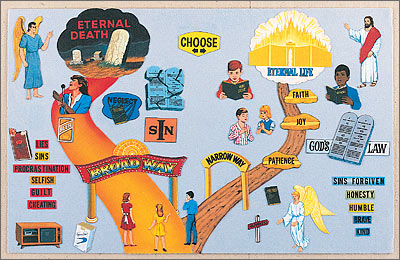
From this concise and powerful illustration we are led to understand that coming to Messiah and entering into His Kingdom requires at least two important steps: First, entering a GATE, and second, walking along a PATH or DERECH (WAY). Therefore when Messiah invites the unsaved to come to Him, He is telling them that, first, they must come to the Gate, which is a very small one. It is small because He -- and He alone -- is the Derech (Way) to Elohim (God) the Father. There are no other entrances.
Finding Messiah, and accepting Messiah as the only Derech (Way) to Elohim (God), is not enough. There is a road or a way to be walked. And notice that the first Christians were especially called followers of the Derech (Way) and not of the Gate.
Going through a gate is a single event but walking along a path is a process that takes time. And it is this 'process', or journey along the derech (way), which is the essence of true Christianity.
Please note how Yah'shua (Jesus) describes both the Gate and the Way -- the Gate is small (and therefore not easy to find) and the Derech (Way) is narrow (and therefore not easy to pass along). The true path to salvation is therefore hard to find and even harder to walk along. It is strict.
Yah'shua (Jesus) said:
"Enter through the narrow gate. For wide is the gate and broad is the road that leads to destruction, and many enter through it" (Matt.7:13, NIV).
What is this Path and how does one walk along it?
Identifying the Derech (Way)
When Yah'shua (Jesus) described the Besorah (Gospel) as the "Way" He was using a very old designation indeed, and one that could be clearly understood by those He was speaking to. Moses said:
"If You are pleased with me, teach me your ways so that I may know You and continue to find favour with You" (Ex.33:13, NIV).
The world, in sharp contrast, says:
"Leave us alone! We have no desire to know Your ways" (Job 21:14, NIV).
The Psalmist, who knew where to find salvation, declared:
"May Elohim (God) be gracious to us and bless us and make His face shine upon us, Selah, that your ways may be known on earth, your salvation among all nations" (Psa.67:1-2, NIV).
And as a warning against those who presume to declare what they suppose the Path of Salvation to be, Ezekiel sternly says:
"Yet you say, 'The Derech (Way) of Yahweh is not just.' Hear, O House of Israel: Is My Derech (Way) unjust? Is it not your ways that are unjust?" (Ezek.18:25, NIV)
So let us be clear: the Derech (Way) of Yahweh is strict and it is just. And it is the ways of man which are unjust because they choose to either ignore the Davar Elohim (Word of God), or dilute it in order to make the Way broader. But the true Derech (Way) isn't broad. It is extremely narrow. Yah'shua (Jesus) said so and no-one professing the Name of the Messiah has any right to say otherwise.
So, what was this "Derech (Way) of Salvation" that was proclaimed by Moses, Job, David, Isaiah and Ezekiel? There is not the slightest doubt that in the Tanakh (Old Testament) the DERECH (WAY) was synonymous with Yahweh's mitzvot (commandments). And if you read Psalm 119 from beginning to end you will be in no doubt as to what the Derech (Way) is -- it is the path of MORAL AND ETHICAL CONDUCT:
"Blessed is the man who does not walk in the counsel of the wicked or stand in the way of sinners or sit in the seat of mockers....the wicked will not stand in the judgment, nor sinners in the assembly of the righteous" (Psa.1:1,6, NIV).
The Master Yah'shua the Messiah (Jesus Christ) taught exactly the same Derech (Way) that was taught by nevi'im (prophets) of the Tanakh (Old Testament). The Master Yah'shua (Jesus), who is identified as the Elohim (God) of the Yanakh (Old Testament) as well as the New is, according to Paul, "the same yesterday and today and forever" (Heb.13:8, NIV). Therefore, he says, "do not be carried away by all kinds of strange teachings" (v.9a). And there are plenty of those today.
The Derech (Way), then, is moral holiness. Indeed, Yah'shua (Jesus) puts it even more bluntly, telling all believers: "BE PERFECT" (Matt.5:48).
The Way to Perfection
As all Christians will acknowledge, ahavah (love) is the greatest mitzvah (commandment). But in defining what ahavah (love) is, Christians divide up into a legion of different schools of interpretation. If you search through the Messianic Scriptures (New Testament), you will find plenty of instruction on the Derech (Way) to Perfection.
One of the most important sources of this instruction, because it is so clear, and even more importantly because it came from the Master's own lips, is the story of the rich young man who sought after eternal life:
"'Teacher, what good thing must I do to get eternal life?' 'Why do you ask Me about what is good?' Yah'shua (Jesus) replied. 'There is only One who is good. IF YOU WANT TO ENTER INTO CHAYIM (LIFE), OBEY THE MITZVOT (COMMANDMENTS)'" (Matt.19:17, NIV).
And who, or what is Chayim (Life)? As we have seen, Yah'shua (Jesus) is Chayim (Life). How do we therefore enter it? By acknowledging Yah'shua (Jesus) as the Gate and then living the mitzvot (commandments)! But which mitzvot (commandments) did Yah'shua (Jesus) mean? Let's see. Continuing with the story:
"'Which (mitzvot/commandments should I obey)?' the man inquired. Yah'shua (Jesus) replied, ''Do not murder, do not commit adultery, do not steal, do not give false testimony, honour your father and mother,' and 'love your neighbour as yourself.'" "All these I have kept," the young man said. "What do I still lack?" Yah'shua (Jesus) answered, "If you want TO BE PERFECT, go, sell your possessions and give to the poor, and you will have treasure in heaven. Then come, follow Me" (v.18-21).
Well, as you know, he coveted money. He loved money more than Elohim (God). But this isn't all that's important about this story. For Yah'shua (Jesus) gives us detailed instructions about the Derech (Way). It is first, obeying the mitzvot (commandments) as were given through Moses; it is then about sacrificing everything for the sake of Yah'shua (Jesus); and then it is a question of following Him...becoming His talmid (disciple). That, He says, is the path of perfection, by following the Perfect One.
I want you to note carefully that following the Torah (Law), and specifically here the 10 Commandments, is a vital part of the Derech (Way). Yah'shua (Jesus) was most emphatic about His talmidim (disciples) obeying the Torah (Law). He said:
"I tell you the emet (truth) (and remember, Yah'shua/Jesus) IS the Emet/Truth), until heaven and earth disappear, not the smallest letter, not the least stroke of the pen, will by any means disappear from the Torah (Law of Moses) until everything is accomplished" (Matt.5:18)
If you have read the Torah (Law) of Moses in the Tanakh (Old Testament) you will know that in it Yahweh does not beat about the bush. He is direct, uncompromising, and unambiguous. Sin is sin and you are left in no doubt that it is so. And what was sin in the Tanakh (Old Testament) is still sin in the Messianic Scriptures (New Testament).
Warning against those who had a tendency to dilute the Besorah (Gospel) to make it more palatable to sinners, Yah'shua (Jesus) reminds us what true ahavah (love) is:
"If ye love Me, ye will keep My mitzvot (commandments)" (John 14:15, KJV).
Yah'shua (Jesus) obeyed the Torah (Law) of Moses to the letter, elevating it above the crass legalism to which it had fallen, and reforming it in areas where it needed reformation. So why, if the followers of the Derech (Way) were living the Torah (Law) strictly according to what was revealed by Moses, did the Jews call them a "sect"?
The Pharisees, who were the self-appointed custodians of the Torah (Law), constantly sought opportunity to find fault with Yah'shua (Jesus) and His followers. Yet Yah'shua (Jesus) taught His talmidim (disciples):
"For I tell you that unless your righteousness surpasses that of the Pharisees and the teachers of the Torah (Law) [of Moses], you will certainly not enter the Kingdom of Heaven" (Matt.5:20, NIV).
Even Stricter than the Law of Moses
Because Yah'shua (Jesus) emphasised ahavah (love), forgiveness and mercy, many Christians erroneously suppose that this was all He ever taught. Indeed, His teaching was simply a reaffirmation of the heart of the Torah (Law) of Moses, which was a Torah (Law) of Ahavah (Love). And ahavah (love), He consistently taught, was obedience to the mitzvot (commandments).
How else could the Derech (Way) be "narrow"? Is a gospel that teaches that all you have to do is have ahavah (love) in your heart but pay no attention to the moral and ethical conduct the "narrow" way? No, it is not. In truth, it is a broad one. It is a false gospel that teaches it doesn't matter what you do so long as you forgive.
Messianic Evangelicals have a reputation for teaching a "strict gospel" and many react strongly against it. But in truth it follows the B'sit Chadashah (New Covenant) teaching of Yah'shua (Jesus) to the very letter. It is not legalistic for it exalts ahavah (love), mercy, compassion and forgiveness, but neither does it neglect justice. We are not liked because we throw out unrepentant fornicators and adulterers, and those who maliciously speak evil. Yet the Bible plainly teaches:
"I wrote to you in my previous letter not to associate closely and habitually with unchaste (impure/sexually immoral) people...(do) not associate with anyone who bears the name of Christian brother, if he is known to be guilty of immorality or greed, or is an idolater -- that is, whose soul is devoted to any object that usurps the place of Elohim (God) -- or is a person with a foul tongue (railing, abusing, reviling, slandering), or is a drunkard, or a swindler or a robber. No, you must not so much as eat with such a person...Drive out that wicked one from among you -- expel him from your assembly (church)" (1 Cor.5:9-13. Amplified Bible).
We are strict and follow the Davar (Word) carefully. (For a more detailed discussion, see Apostolic Interviews No.1: A Question of Fellowship). Yah'shua (Jesus) commands it. The former shlichim (apostles) taught it and the modern shlichim (apostles) teach it too.
So strict is the Davar Elohim (Word of God) that it is "sharper than any double-edged sword, it penetrates even to dividing soul and spirit, joints and marrow; it judges the thoughts and attitudes of the heart. Nothing in all creation is hidden from Elohim's (God's) sight. Everything is uncovered and laid before the eyes of Him to whom we must give account" (Heb.4:12, NIV).
Have you compromised the Davar Elohim (Word of God)? Have you tried to dilute the message of Messiah? Do you "publically malign the Derech (Way)"? (Acts 19:9) If you have, or if you do, then now is the time to repent and enter into His rest:
"Let us, therefore, make every effort to enter into that rest, so that no one will fall by following their example of disobedience" (v.11).
If you wish to know the ahavah (love) of Yahweh, know His simcha (joy), inner shalom (peace), strength, and glory, then you must obey the strictness of His mitzvot (commandments):
"So be careful to do what Yahweh your Elohim (God) has commanded you; do not turn aside to the right or to the left" (Deut.5:32, NIV).
The Restoration of the Way
The New Covenant Assemblies of Yahweh (NCAY) is a restoration of the early Messianic Community (Church) and is not bound by any tradition or teaching of man but is built upon the revelation of the Besorah (Gospel) of Yah'shua (Jesus) the Messiah.
We invite all those who really want to know what the true derech (Way) is, to enjoy both its strictness and the fruits of that strictness, perfect shalom (peace) and ahavah (love). We seek for those who desire to follow Yah'shua (Jesus) in all things, and we invite you to come and partake of the grace which has been given us. Amen.

This page was created on 28 December 1997
Last updated on 23 February 2015
Copyright © 1987-2015 NCCG - All Rights Reserved